Our Short List of 3

All 3 Picks at a Glance
| Product | Specs | Action |
|---|---|---|
 1. OPTIMA D34M BlueTop Dual Purpose AGM Battery | Check price on Amazon | |
| 2. Interstate Batteries Marine and RV Group 31M Dual Purpose AGM Battery | Check price on Amazon | |
| 3. Interstate Batteries Marine Deep Cycle Group 31 AGM Battery 31-AGM5 | Check price on Amazon |
Key takeaways
- Find the best engine marine battery for reliable boat starts. Compare sealed AGM starting batteries by cranking amps, reserve capacity, and group size.
A dead battery at the ramp or at anchor turns a good day on the water into a long one. The best engine marine battery is the one that cranks your outboard or sterndrive the first time you turn the key, holds up to pounding waves and vibration, and still has enough reserve left to run the bilge pump and electronics after the engine is off. Marine starting batteries live a harder life than car batteries. They sit unused for weeks, face humidity and salt spray, and get shaken by every wave the hull crosses.
This guide focuses on sealed AGM marine batteries built for engine starting. Every battery here is a dual-purpose AGM that lists a real cold cranking amps rating and is sold for boat and RV use. That matters because a pure deep-cycle battery is built to deliver steady power over hours, not the short, heavy burst an engine starter demands. Dual-purpose AGM batteries split the difference, giving you strong cranking plus enough reserve to run accessories between starts.
Before you buy, check three things on your current battery and your boat. First, the group size printed on the old battery case, because the tray and hold-down were built around it. Second, the cranking amps your engine manual calls for, especially if you run a large outboard or a diesel. Third, the terminal style, since marine batteries use a mix of automotive posts and threaded studs.
As an Amazon Associate, we earn from qualifying purchases.
Quick Answer
The best engine marine battery for most boat owners is a sealed AGM dual-purpose battery with a cold cranking amps rating that meets or beats the engine maker requirement, a group size that matches the existing tray, and marine terminals that suit the boat wiring. The OPTIMA D34M BlueTop leads for compact single-battery boats, while the larger Interstate Group 31 options suit bigger engines and heavier accessory loads.
How to Choose
Choosing a marine starting battery starts with the engine, not the battery shelf. Your outboard or sterndrive manual lists a minimum cold cranking amps figure, and that number is the floor. Cold cranking amps measure how much current the battery can deliver for thirty seconds at zero degrees Fahrenheit while staying above a set voltage. A battery rated below the engine requirement may crank fine on a warm afternoon and fail on a cold morning. Pick a battery rated at or above the manual figure, with some margin if you boat in cold water or run a high-compression engine.
Group size comes next. Group 24, Group 27, Group 31, and Group 34 are the common marine sizes, and each one describes a case footprint and terminal layout. A Group 31 battery is longer and heavier than a Group 34, and it will not fit a tray built for the smaller case. Measure the tray length, width, and height, and check the clearance under the hatch or seat. Also check the hold-down hardware. A battery that rocks in its tray will fail early, because vibration is one of the fastest ways to damage internal plates. Sealed AGM construction helps here, since the plates are held tight and the battery resists vibration better than a flooded battery.
Reserve capacity is the third number worth reading. It measures how many minutes the battery can deliver a steady draw before voltage drops too low. A higher reserve capacity means more time running the fishfinder, livewell pump, lights, and stereo with the engine off. Boaters who anchor for hours care about this number. Boaters who start the engine, run to a spot, and start again care less, but reserve capacity still matters as a safety margin if the alternator or charger has a problem.
Chemistry shapes everything else. Sealed AGM batteries dominate marine starting duty for good reasons. They are maintenance free, they do not spill acid when the boat heels or pounds, they recharge faster than flooded batteries, and they tolerate vibration. Flooded marine batteries cost less up front but need water checks, venting, and careful mounting. Lithium marine batteries are lighter, but many outboard makers still specify lead-acid charging profiles. For most owners, AGM is the safe middle ground.
Terminals deserve a close look before ordering. Many marine batteries carry dual terminals: standard automotive posts plus threaded stainless steel studs. Dual terminals make it easy to connect the starter cable to one post and accessory wiring to the other, which keeps the installation clean. If your boat uses wing nuts on studs, confirm the stud size matches your cable lugs.
Weight is a practical concern on smaller boats. A Group 31 AGM can weigh around sixty pounds, while a Group 34 AGM weighs closer to forty pounds. That difference matters when you carry the battery down a dock or lift it into a tight compartment. Do not pick a heavier battery than the boat needs unless the extra capacity serves a real purpose.
Charging compatibility is the last check. AGM batteries charge on most modern marine chargers and alternators, but they prefer a charging profile set for AGM rather than flooded. If your onboard charger has a battery type selector, set it to AGM. A battery charged on the wrong profile will not reach full charge, and repeated undercharging shortens its life. Keep the terminals clean, keep the battery secured, and top up the charge after every trip.
1. OPTIMA D34M BlueTop Dual Purpose AGM Battery
The OPTIMA D34M BlueTop is the compact dual-purpose AGM that many single-battery boat owners reach for first. It is a Group 34 battery, so it fits trays that cannot take a full-size Group 31, and it weighs less than the big Group 31 options while still listing a solid cranking rating. Its SpiralCell construction winds the plates into tight spirals, which helps the battery resist vibration from pounding water and rough trailering. For a boat that starts one engine and runs a modest set of electronics, the D34M covers both jobs from a single battery and a single charging system.
The D34M lists 750 cold cranking amps and 870 marine cranking amps, with 55 amp hours of capacity and 120 minutes of reserve capacity. That cranking output suits mid-size outboards and sterndrives, and the reserve capacity gives enough time to run a fishfinder, lights, and stereo at anchor without immediately worrying about the next start. The battery is sealed and maintenance free, so there is no water to check and no acid to spill when the boat heels. It mounts in almost any position, which helps in tight compartments where a flooded battery would be a poor fit.
Dual terminals are a practical advantage. The D34M carries both standard SAE posts and stainless steel studs, so the starter cable and the accessory wiring can each have a clean connection. The battery measures about ten inches long, just under seven inches wide, and just under eight inches tall, which matches the standard Group 34 footprint. At around forty-three pounds it is manageable for one person to carry and install.
The trade-off is capacity. Fifty-five amp hours is modest next to a Group 31 battery, so the D34M is not the right choice for a boat that runs a refrigerator, a big stereo, and a full electronics suite at anchor for hours. That kind of load belongs on a separate deep-cycle house bank, with the D34M handling starting duty.
Who Should Skip It
Skip the OPTIMA D34M BlueTop if your boat runs a large accessory load at anchor for hours, or if your engine manual calls for more cranking amps than this battery lists. Boats with a refrigerator, a livewell running all day, and a full electronics suite will drain fifty-five amp hours quickly, and a larger Group 31 battery or a separate house bank is the better answer. Also skip it if your tray is built for Group 31 and you want the extra capacity that size offers, since the smaller Group 34 case leaves space unused.
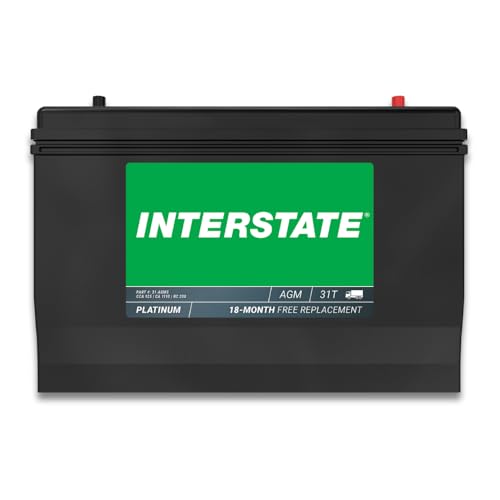
2. Interstate Batteries Marine and RV Group 31M Dual Purpose AGM Battery
The Interstate Batteries Group 31M dual-purpose AGM is the larger, higher-capacity option for boats with bigger engines and heavier electrical loads. It lists 825 cold cranking amps and 100 amp hours of capacity in a Group 31 case, which gives it both stronger starting output and far more reserve than a compact Group 34 battery. The pure lead AGM construction is built to deliver high cranking power and deep-cycle endurance in the same battery, so it suits boats that start a large outboard and then run electronics, pumps, and accessories for hours.
This battery is aimed squarely at boat and RV owners who need one battery to do two jobs. The 825 cold cranking amps rating covers large outboards and sterndrives that a smaller battery might struggle with on a cold morning. The 100 amp hour capacity gives real time at anchor, running the fishfinder, livewell, lights, and stereo without immediately draining the starting reserve.
The Group 31 case measures about thirteen inches long, which is the largest common marine footprint, so tray fit is the first thing to check. The battery weighs more than a Group 34, and installation is a two-hand job for most people. That weight buys capacity, though, and for a boat already set up for Group 31, the fit is straightforward. The battery is sealed and maintenance free, with no water to check and no acid spill risk.
One practical note is that Interstate sells several Group 31 marine batteries with similar names, so confirm the part number and the listed cranking rating before ordering. The dual-purpose Group 31M described here is the one listing 825 cold cranking amps and 100 amp hours for marine and RV starting duty.
Who Should Skip It
Skip the Interstate Group 31M if your battery tray is built for Group 24, Group 27, or Group 34, because the Group 31 case will not fit without modifying the tray and hold-down. Skip it too if your boat is small and weight-sensitive, since the larger case adds meaningful weight to the hull. Boaters with a small outboard and a light electrical load will get everything they need from a smaller, lighter battery and will not use the extra capacity this one carries.
3. Interstate Batteries Marine Deep Cycle Group 31 AGM Battery 31-AGM5
The Interstate Batteries 31-AGM5 is the heavy-duty Group 31 AGM in this guide, and it carries the highest cranking rating of the three picks. It lists 925 cold cranking amps, 1,110 cranking amps, 100 amp hours of capacity, and 200 minutes of reserve capacity. That combination makes it the strongest choice here for a large engine that demands high cranking output, and for a boat that runs a full electronics suite at anchor for long stretches. Interstate describes it as a two-in-one pure lead AGM battery that delivers high cranking and deep-cycle power, and the listing names a boat motor, trolling motor, and onboard accessories among its intended loads.
The 31-AGM5 is built with thick plates that support repeated deep discharge and recharge, which is why it suits boats that cycle the battery hard. A boat that starts a big outboard, runs to a fishing spot, sits for hours on electronics and livewell pumps, then starts again and runs home, puts exactly this kind of demand on a battery. The 200 minutes of reserve capacity gives a generous margin for that pattern, and the 925 cold cranking amps rating gives a margin for cold mornings and high-compression engines.
Fit is the main consideration. The 31-AGM5 is a Group 31 battery, about thirteen inches long and around sixty pounds, so it needs a Group 31 tray, a solid hold-down, and enough hatch clearance. The terminals are marine style, and the battery is sealed AGM, so there is no water to check and no spill risk when the boat pounds through chop.
Who Should Skip It
Skip the Interstate 31-AGM5 if your tray is not built for Group 31, or if the sixty-pound weight is a problem for your boat or your back. Small boats with modest outboards do not need 925 cold cranking amps, and the extra weight and size buy capacity that will go unused. Also skip it if your engine maker specifies a different battery chemistry or charging profile, since this is a lead-acid AGM battery and needs a charger set for AGM.
FAQ
What size marine battery do I need to start my engine?
Match the group size to your battery tray and the cold cranking amps rating to your engine manual. The manual lists a minimum cranking figure, and the battery you buy should meet or beat it. Measure the tray before ordering, because a Group 31 battery will not fit a tray built for Group 34, and a loose battery fails early from vibration.
Can a deep-cycle marine battery start a boat engine?
A pure deep-cycle battery is built for steady power over hours, not the short heavy burst a starter motor draws, so it is the wrong tool for engine starting on its own. A dual-purpose AGM battery is different, because it is built to deliver both a strong cranking burst and steady accessory power. Check the listed cold cranking amps rating and confirm it meets your engine requirement before relying on any battery for starting duty.
How long should a marine starting battery last?
Lifespan depends on use, charging, and storage. A sealed AGM battery that is kept charged after every trip, secured against vibration, and stored charged over the off season will serve for several seasons. Repeated deep discharge, chronic undercharging, and a loose hold-down shorten life. A battery that cranks slowly after a full charge, or one that will not hold a charge, is ready for replacement.
Do I need a special charger for an AGM marine battery?
Most modern marine chargers and alternators work with AGM batteries, but the charger should be set to an AGM profile where a selector is available. An AGM profile charges at the voltage the battery maker intends, and charging on a flooded profile can leave the battery undercharged over time. Check the charger manual, set the battery type correctly, and top up the charge after every trip.
Final Verdict
The best engine marine battery is the sealed AGM dual-purpose battery that matches your engine cranking requirement, fits your tray, and carries enough reserve for the way you boat. The OPTIMA D34M BlueTop is the pick for compact single-battery boats, where its Group 34 size, lighter weight, and 750 cold cranking amps cover a mid-size outboard and a modest electronics load. The Interstate Group 31M steps up to 825 cold cranking amps and 100 amp hours for bigger engines and longer days at anchor. The Interstate 31-AGM5 leads the group with 925 cold cranking amps and 200 minutes of reserve capacity, making it the strongest choice for a large engine and a heavy accessory load.
Measure the tray, read the engine manual, and buy the battery that fits both. Keep it secured, keep it charged, and the right marine starting battery will crank first time, season after season.
Product and ASIN Reference
| Product | ASIN |
|---|---|
| OPTIMA D34M BlueTop Dual Purpose AGM Battery | B00075OSCO |
| Interstate Batteries Marine and RV Group 31M Dual Purpose AGM Battery | B0BHTT7K4J |
| Interstate Batteries Marine Deep Cycle Group 31 AGM Battery 31-AGM5 | B0BHX3FBCQ |