Key takeaways
- Five screen tents compared for bug-free camping, picnics, and backyard meals, from a one-minute Coleman to a rugged Gazelle hub gazebo, with setup tips.
A screen tent turns a buggy yard or a mosquito-heavy campsite into a usable outdoor room. Fine mesh walls keep biting insects out while letting air move through, and a solid roof blocks sun and light rain. The best models set up in about a minute, fit over a picnic table, and pack down small enough to ride along on a weekend trip.
The difference between a good screen tent and a frustrating one usually comes down to setup and frame design. Hubbed fiberglass poles pop open fast but pack long. Spring-loaded frames open themselves and weigh less but give up wind strength. Steel instant canopies are sturdy and tall but heavy. This guide compares five proven shelters across those trade-offs so you can match one to how you actually camp and entertain.
As an Amazon Associate, we earn from qualifying purchases.
Quick Answer
The Coleman Skylodge 10 x 10 Instant Screen Canopy Tent is the best screen tent for most people because it sets up in about a minute, fits a picnic table with chairs, and uses a sturdy steel frame with two doors. Campers who want the toughest hubbed shelter should look at the Gazelle G6, while the CLAM Quick-Set Escape is the fastest six-sided option for frequent movers.
How to Choose a Screen Tent
Start with size. A 10 by 10 foot tent fits a standard picnic table with room for chairs around it, which covers most families. A 12 by 12 foot tent adds space for a table plus a cooler and a couple of extra chairs, but it weighs more and packs longer. Measure your table first, then check the tent’s inner dimensions rather than the hub-to-hub span, since sloped walls steal usable floor space near the edges.
Setup style matters more than it looks on a spec sheet. Instant canopies use pre-attached telescoping poles and a central hub, so one person can raise them in about a minute. Hubbed fiberglass panels pop open wall by wall and are very fast once you learn the motion, but the packed bundle is long, often six feet or more. Spring-loaded pop-up frames open themselves the moment you release the strap, which is the lightest and simplest option, though the frame flexes more in wind.
Check the mesh and the roof separately. Fine no-see-um mesh keeps out the smallest biting insects, while standard mesh stops mosquitoes and flies but may let tiny midges through. The roof should be a solid fabric panel, not mesh, so it sheds light rain and blocks direct sun. A polyurethane coating rating on the roof fabric tells you how much rain pressure it resists before water pushes through.
Wind handling is where cheap shelters fail. Look for guy lines, ground stakes, and sandbags included in the box, plus tie-down points on the walls. A tent with vertical walls catches more wind than one with sloped walls, so it needs better anchoring. Never leave a screen tent up in a storm, and take it down when gusts approach the maker’s stated limit.
Weight and packed size decide whether the tent actually travels with you. A 12-pound spring-loaded shelter rides in any trunk. A 34-pound hubbed shelter needs a long, flat load space and a second pair of hands for the carry. If you camp solo or pack a small car, weight and packed length matter as much as floor area.
Finally, count the doors and check the floor. Two doors let people come and go without crawling past the table, and a zippered door keeps bugs out better than a magnetic flap. Most screen tents have no floor, which is fine on grass but lets ground moisture and crawling insects in. A removable floor is a bonus for beach sand and wet grass, not a requirement for a patio.
Best Screen Tents
Coleman Skylodge 10 x 10 Instant Screen Canopy Tent — Best Overall

The Coleman Skylodge is the easiest screen tent for most people to live with. Its pre-attached telescoping poles and central hub raise the whole shelter in about a minute, and the design is simple enough that one person can set it up without help. Two zippered doors sit on opposite sides, so nobody has to climb over the table to get out, and the steel frame feels solid once the legs are locked.
The roof uses Coleman’s UVGuard material for sun protection, and the mesh walls keep mosquitoes and flies out while letting a breeze through. Sloped walls and legs help the tent hold its shape on uneven ground, though the slope trims a little headroom near the edges. The 10 by 10 foot footprint fits a standard picnic table with chairs, which is the size most families actually need.
Specs
- Size: 10 x 10 feet
- Setup: About 1 minute, instant hub with telescoping poles
- Frame: Steel, pre-attached poles
- Doors: 2 zippered doors
- Sun protection: UVGuard roof material
CLAM Quick-Set Escape 11.5 x 11.5 Pop-Up Screen Tent — Best Fast Setup

The CLAM Quick-Set Escape is the original six-sided pop-up screen shelter, and it remains one of the fastest to deploy. The hubbed fiberglass walls pop open in about 45 seconds with no assembly, and the six-sided shape gives more usable floor space than a square tent of the same span. A picnic table fits inside with room for chairs around it.
The no-see-um mesh is finer than standard screen, so it stops the smallest biting insects as well as mosquitoes. The roof is water-resistant 210 denier fabric with taped seams, and an extra-wide skirt at the base helps keep wind-driven rain and crawling insects out. Seven stakes and five tie-down ropes come in the box, along with an oversized carry bag that makes repacking far less of a struggle than with most pop-up shelters.
Specs
- Size: 11.5 x 11.5 feet inner, 7.5 feet center height
- Setup: About 45 seconds, hubbed fiberglass walls
- Frame: Fiberglass, 6-sided hub design
- Weight: 34 pounds
- Mesh: No-see-um mesh, 210 denier water-resistant roof
Gazelle G6 6-Sided Portable Gazebo — Best Pop-Up

The Gazelle G6 is built for campers who move often and camp in rough places. Its hubbed-panel design pops open in under 90 seconds, and the stiff vertical walls give more headroom and living space than sloped-wall tents. Three wind panels come included, and Gazelle sells add-on panels and a waterproof ground footprint for wet ground.
The G6 was designed for overland camping, so the materials are a step above most pop-up shelters. The TriTech mesh and heavy fabric hold up to repeated setup cycles, and the hubbed walls handle wind better than spring-loaded frames, especially with guy lines attached to the center of each wall. The trade-off is bulk: the packed case is about six feet long and the shelter weighs 34 pounds, so it suits a truck bed or a large trunk better than a small car.
Specs
- Size: 12 x 12 feet, 7 feet height, 86 square feet usable
- Setup: Under 90 seconds, hubbed fiberglass panels
- Frame: Fiberglass hubbed walls, vertical sides
- Weight: 34 pounds
- Included: 3 wind panels, stakes, carry bag
Browning Basecamp Screen House — Best Wind Resistance

The Browning Basecamp is the pick for exposed sites where wind is the main problem. Its elastic-cord fiberglass pole frame is reinforced at the joints, and the roof fabric carries a 1500mm polyurethane coating, which resists rain pressure better than the lighter coatings on most screen tents in this size class. The frame flexes in gusts instead of fighting them, which keeps poles intact when a storm rolls through.
At 12 by 10 feet with a 7.4 foot peak, the Basecamp fits a picnic table and chairs with room to move. It packs down to about 2.3 feet by 8.5 inches, which is shorter than most hubbed shelters, and at 17.9 pounds it is light enough for one person to carry to the site. Setup takes a few minutes with the elastic-cord poles, so it is slower than the instant and hubbed models here, but the wind handling is worth the extra time on open ground.
Specs
- Size: 12 x 10 feet, 7.4 feet peak height
- Setup: Elastic-cord fiberglass poles, a few minutes
- Frame: Fiberglass with reinforced joints
- Weight: 17.9 pounds
- Roof: 1500mm polyurethane coating
Alvantor Screen House Room 10 x 10 — Best Lightweight
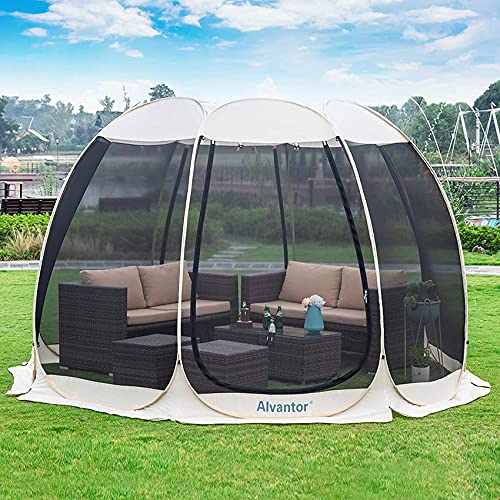
The Alvantor Screen House is the lightest shelter in this guide and the simplest to set up. The pre-strung fiberglass ribs spring open on their own the moment you release the strap, so the tent is up in well under a minute with no poles to thread and no hub to push. At 12 pounds it is easy for one person to carry, and it packs into a flat circular bag.
The hexagonal shape gives 360-degree ventilation through fine mesh walls, and the roof carries UPF 50+ sun protection. The trade-off is weather: the mesh and roof are not waterproof, so this tent is for dry days only, and the maker advises taking it down when wind reaches 24 to 30.8 miles per hour. Twelve stakes, twelve guy lines, and six sandbags come included, and you should use all of them. For fair-weather picnics and backyard meals, it is the easiest shelter here to own.
Specs
- Size: 10 x 10 feet, 7 feet height, 100 square feet
- Setup: Spring-loaded automatic pop-up, under 1 minute
- Frame: Fiberglass, hexagonal
- Weight: 12 pounds
- Sun protection: UPF 50+ roof, mesh walls not waterproof
Who Should Skip It
A screen tent is the wrong shelter if you need real rain protection or a place to sleep. Mesh walls stop bugs, not rain, and even the best roof coating here will not keep a heavy downpour out of a screen room. If your trips run through wet weather, a solid-wall canopy or a full tent with a rainfly is a better tool.
Very small cars and solo backpackers should also skip the big hubbed models. A six-foot packed case does not fit every trunk, and a 34-pound shelter is a lot to haul alone. The lightweight Alvantor is the exception, but it gives up wind strength in return.
Finally, skip a screen tent if your yard already has a screened porch or a permanent gazebo. A fixed structure does the same job without the setup, the storage, and the wind worry, and it lasts far longer than any portable shelter.
FAQ
Do screen tents keep out no-see-ums?
It depends on the mesh. Shelters with fine no-see-um mesh, like the CLAM Quick-Set Escape, stop the smallest biting insects. Standard mesh stops mosquitoes and flies but may let tiny midges through, so check the mesh description before you buy if no-see-ums are your main problem.
Can one person set up a screen tent alone?
Yes, with the right design. Instant canopies and spring-loaded pop-ups are built for solo setup, and hubbed models like the Gazelle G6 and CLAM Escape are also manageable alone once you learn the motion. Heavier steel-frame models are easier with a second person, mostly for lifting the packed case.
Are screen tents waterproof?
No. Screen tents are water-resistant at best. The roof sheds light rain, and coated fabrics resist more, but mesh walls let wind-driven rain through. Treat a screen tent as a bug and sun shelter, and take it down or move under solid cover when heavy rain arrives.
How do I keep a screen tent from blowing away?
Use every stake, guy line, and sandbag that comes in the box, and add heavier stakes on soft or sandy ground. Anchor the walls at their tie-down points, not just the corners, and take the tent down before a storm. A screen tent is a sail in strong wind, so anchoring is not optional.
Final Verdict
The Coleman Skylodge 10 x 10 is the best screen tent for most people because it combines one-minute setup, a sturdy steel frame, and two doors at a size that fits a picnic table. The CLAM Quick-Set Escape is the fastest six-sided shelter and the best choice for frequent movers, while the Gazelle G6 is the toughest pop-up for rough campsites. The Browning Basecamp wins on wind and rain resistance, and the Alvantor is the lightest option for fair-weather days. Pick the size that fits your table, anchor it well, and the bugs can stay outside.
Product and ASIN Reference
| Product | ASIN |
|---|---|
| Coleman Skylodge 10 x 10 Instant Screen Canopy Tent | B0D96K2N75 |
| CLAM Quick-Set Escape 11.5 x 11.5 Pop-Up Screen Tent | B00E3LF7FK |
| Gazelle G6 6-Sided Portable Gazebo | B08TB6DBV8 |
| Browning Basecamp Screen House | B081DMTTPS |
| Alvantor Screen House Room 10 x 10 | B07TXBB49X |