Our Short List of 3

- Listing: AGPTEK A02S 16GB MP3 Player, Dark Blue
- Rated battery life: up to 70 hours of playback
- Battery: built-in lithium-polymer, 420 mAh, with a full charge in about an hour and a half per the listing
- Storage: 16GB built in, expandable with a memory card up to 128GB

- Listing: SanDisk 8GB Clip Sport MP3 Player, Black (SDMX24-008G-G46K)
- Rated battery life: up to 25 hours, based on continuous playback at 128 kbps MP3
- Storage: 8GB built in, plus a microSDHC card slot
- Extras: built-in clip, FM radio, 1.44-inch colour screen
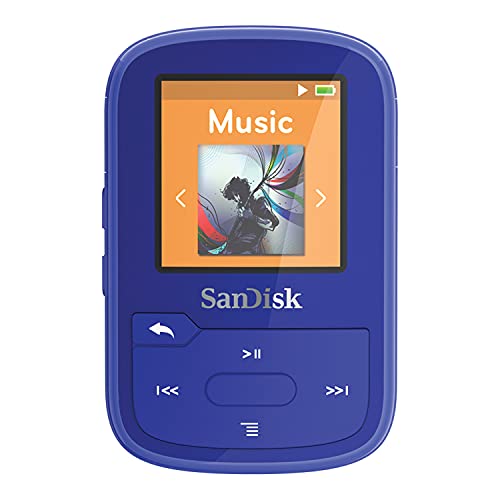
- Listing: SanDisk 16GB Clip Sport Plus MP3 Player, Blue (SDMX28-016G-G46B)
- Rated battery life: up to 20 hours with wired earphones; up to about six and a half hours over Bluetooth, per SanDisk’s listing notes
- Storage: 16GB built in
- Extras: Bluetooth, FM radio, water resistance rated IPX5
All 3 Picks at a Glance
| Product | Specs | Action |
|---|---|---|
| 1. AGPTEK A02S — the runtime specialist |
| Check price on Amazon |
| 2. SanDisk Clip Sport — the balanced clip-on classic |
| Check price on Amazon |
| 3. SanDisk Clip Sport Plus — long life, with a Bluetooth warning attached |
| Check price on Amazon |
Key takeaways
- MP3 player battery life explained: why rated hours differ from real use, how Bluetooth, bitrate and screens drain power, and the long-runtime players worth considering.
As an Amazon Associate we earn from qualifying purchases.
Affiliate Disclosure: This article contains affiliate links. If you buy through links on this page, we may earn a commission from qualifying purchases, at no extra cost to you. Battery figures in this article are the manufacturers’ published ratings, taken from product listings and official documentation, not measurements from our own testing.
Why MP3 Players Still Win on Battery Life
A phone is a computer with a large bright screen, several radios, and dozens of background processes, and even in a dedicated music app it measures listening time in a day or so of playback. A simple MP3 player does one job with a tiny processor, a small screen that is off most of the time, and no cellular radio at all. That is why the best MP3 battery life figures look almost old-fashioned: the longest-running dedicated players are rated for several days of continuous playback from a battery smaller than the one in a pair of wireless earbuds’ charging case.
This article explains how those headline hours are produced, why your real-world runtime will almost always be lower, and which design choices separate a genuinely long-running player from a mediocre one. It then profiles three players with strong published battery figures, each representing a different point on the trade-off between runtime, features, and wireless convenience. Because battery claims are test-condition claims, the honest way to shop this category is to understand the conditions first and the products second.
How Manufacturers Measure Playback Time
Nearly every battery figure in this category carries the same quiet footnote: continuous playback of MP3 files at 128 kbps, at default settings, through wired earphones. SanDisk states this basis explicitly for its Clip players, and Sony’s official help guide for its Walkman players lists its longest figure at the same 128 kbps MP3 setting, with a slightly shorter figure for higher-bitrate AAC files.
Each element of that test flatters the result. A 128 kbps file is small and undemanding to decode. Wired earphones draw their power from a simple amplifier stage rather than a radio. Default settings usually mean moderate volume, no equaliser boosts, and a screen that sleeps. Continuous playback means the device is never woken, searched, or skipped through, all of which cost extra power in real use.
None of this makes the ratings dishonest — a standardised test is the only way to compare players at all — but it does mean the rated figure is a ceiling, not a promise. When you compare two players, compare their rated figures against each other, and then expect both to land lower in your pocket.
The Five Things That Actually Drain an MP3 Player
1. Bluetooth is the biggest single cost
Switching from wired earphones to Bluetooth is the fastest way to cut a player’s runtime, often dramatically. SanDisk’s own documentation for the Clip Sport Plus makes the point with unusual clarity: the same player is rated for up to 20 hours of playback with wired earphones and only around six and a half to seven hours over Bluetooth. The radio, the pairing upkeep, and the more demanding wireless audio codecs all draw from the same small battery. If maximum runtime is your priority, wired listening is not a compromise, it is the main strategy.
2. File format and bitrate
Decoding is work, and harder files mean more work. Lossless formats such as FLAC and APE carry far more data per second than a 128 kbps MP3 and keep the processor and storage busier. High-bitrate files of any format sit between the two. The differences are not enormous on efficient players, but a library of lossless files will consistently finish a charge sooner than the same library as modest-bitrate MP3 or AAC files. Sony’s published figures show the same pattern in miniature, with its AAC rating slightly below its MP3 rating.
3. The screen
A small monochrome or low-resolution colour screen that wakes for a few seconds per track change costs little. A larger touchscreen, kept bright, browsed often, or used for video costs a great deal. This is why the very longest-runtime players are simple button-controlled devices, and why Android-based players with big displays, for all their streaming convenience, sit far down the runtime table despite having much larger batteries. Screen-on time is the variable most users underestimate.
4. Volume and equalisation
Amplifiers draw more current as volume rises, and bass-heavy equaliser settings raise the draw further, particularly with harder-to-drive headphones. Listening loudly on a train with noise around you can cost noticeably more power than quiet listening at home with the same player and the same files. There is no setting to change here beyond awareness: the rated figure assumes a moderate, default listening level.
5. Battery age and temperature
Every player in this category uses a built-in lithium-ion or lithium-polymer battery that is not user-replaceable. These batteries lose capacity with charge cycles and calendar age, so a player that delivered close to its rating when new will deliver less after a few years of regular use. Cold weather temporarily reduces available capacity as well, which matters for winter running and outdoor work. Practical care is simple: avoid leaving the player flat for months, avoid storing it fully charged in heat, and top it up before long trips rather than assuming last month’s runtime still applies.
Reading a Battery Specification Properly
When a listing quotes a battery capacity in milliamp-hours alongside a playback figure, the two numbers together tell you more than either alone. A small battery with a huge playback claim implies a very frugal design — typically a simple player with a tiny screen and no wireless. A large battery with a modest playback claim implies the opposite: a feature-heavy device spending its capacity on a display, radios, and a full operating system.
Charge time deserves the same attention. A player that runs for days but takes half a day to refill is a different ownership experience from one that pairs a slightly shorter runtime with a charge measured in an hour or two. For travel, the combination that matters is runtime per charge plus how quickly a short top-up restores useful listening.
Finally, treat any runtime claim that appears only in a marketplace title, with no test conditions stated anywhere in the listing or the maker’s documentation, as marketing rather than specification. The players below were chosen because their figures come with stated conditions or a documented battery capacity behind them.
Three Players With Genuinely Long Rated Battery Life
1. AGPTEK A02S — the runtime specialist
- Listing: AGPTEK A02S 16GB MP3 Player, Dark Blue
- Rated battery life: up to 70 hours of playback
- Battery: built-in lithium-polymer, 420 mAh, with a full charge in about an hour and a half per the listing
- Storage: 16GB built in, expandable with a memory card up to 128GB
The A02S is the clearest illustration in this category of what simplicity buys. It is a small button-controlled player with no Bluetooth and no touchscreen, a modest display, and support for MP3 and lossless formats including FLAC, WAV, and APE. AGPTEK rates it for up to 70 hours of playback from its 420 mAh battery, a figure that only makes sense — and is only achievable — because there is so little else drawing power. Real listening with lossless files and frequent track changes will land below that ceiling, but even a heavily discounted version of the claim leaves a player that goes many days between charges. It also includes an FM radio and voice recording. For runners, commuters, and anyone who wants to charge a player roughly when they remember rather than every night, this is the benchmark design.
2. SanDisk Clip Sport — the balanced clip-on classic
- Listing: SanDisk 8GB Clip Sport MP3 Player, Black (SDMX24-008G-G46K)
- Rated battery life: up to 25 hours, based on continuous playback at 128 kbps MP3
- Storage: 8GB built in, plus a microSDHC card slot
- Extras: built-in clip, FM radio, 1.44-inch colour screen
The Clip Sport’s 25-hour rating is more modest than the AGPTEK’s headline, and SanDisk states its test basis plainly, which makes the figure easy to interpret: wired listening, standard files, default settings. In exchange for the shorter runtime you get the Clip line’s defining convenience, a body that clips to a waistband or strap and effectively disappears during exercise, plus card expansion that the newer Plus model dropped. The battery is not replaceable, as with every player here. For gym and running use where the player is charged weekly alongside other kit, 25 honest hours is comfortably enough, and the clip is the reason this design has stayed popular for years.
3. SanDisk Clip Sport Plus — long life, with a Bluetooth warning attached
- Listing: SanDisk 16GB Clip Sport Plus MP3 Player, Blue (SDMX28-016G-G46B)
- Rated battery life: up to 20 hours with wired earphones; up to about six and a half hours over Bluetooth, per SanDisk’s listing notes
- Storage: 16GB built in
- Extras: Bluetooth, FM radio, water resistance rated IPX5
The Clip Sport Plus is included less for its headline figure than for what it teaches. It adds Bluetooth and water resistance to the Clip formula, keeps a respectable 20-hour wired rating, and then demonstrates the Bluetooth cost in its own documentation: connect wireless earbuds and the same battery is rated for roughly a third of the runtime. That is not a flaw in this particular player; it is the physics of every small player with a radio. Buy it if you want the option of wireless listening for workouts and wired listening for travel, and plan your charging around the mode you actually use. Judged purely as a wired player, it remains a solid long-life choice with a bigger fixed memory than the older Clip Sport.
How the Rest of the Market Compares
Beyond these three, the pattern across the category is consistent. Basic button-controlled players from specialist brands regularly publish ratings between roughly 40 and 70 hours, always on the same wired, standard-file test basis. Classic Walkman designs from Sony publish figures in the mid-thirties of hours under their stated conditions, reflecting slightly larger screens and feature sets than the simplest players. Touchscreen and Android-based players, despite batteries several times larger, typically publish figures in the twenties of hours or below, because the display and operating system spend the extra capacity. And any player whose main selling point is streaming over WiFi should be judged as a small computer, not as an MP3 player, when it comes to charging habits.
The practical conclusion is that the best MP3 battery life does not come from the biggest battery. It comes from the shortest feature list that still does what you need.
Getting the Most Hours From Any Player
A few habits close most of the gap between rated and real runtime. Listen wired when runtime matters and save Bluetooth for when it is genuinely more convenient. Set the screen to sleep quickly and resist browsing with the display lit. Keep volume at the lowest level that is comfortable, and be aware that heavy bass equalisation costs power as well as changing the sound. If your library is lossless, consider keeping a smaller MP3 or AAC copy on the player for long trips. Charge before the battery is completely flat, store the player with a partial charge if it will sit unused for months, and keep it out of hot cars and cold bags where possible. None of these habits is dramatic; together they are the difference between a player that matches its reputation and one that always seems to die early.
Verdict
If best MP3 battery life is your single priority, the AGPTEK A02S and its up-to-70-hour rating show what a simple, wired, button-controlled design can do, and it is the natural first choice for maximum days between charges. The SanDisk Clip Sport remains the balanced pick for exercise, trading a lower but clearly documented 25-hour rating for its clip-on body and card slot. The Clip Sport Plus suits listeners who want Bluetooth available, provided they understand from its own published figures that wireless listening cuts runtime to roughly a third. Whichever player you choose, read the test conditions behind the number before you compare it with anything else — in this category, the footnote is the specification.