Key takeaways
- Compare the best weather stations for home and garden use, from WiFi smart stations to pro-grade accuracy, and pick the right fit for your yard.
A weather app tells you what is happening across town. A home weather station tells you what is happening in your own yard, at the fence line, above the garden beds, and on the roof where the wind actually blows. That local detail changes real decisions: whether to water the garden tonight, whether to cover tender plants before a frost, and whether the rain that fell overnight was a light sprinkle or a soaking storm.
The five stations below cover the full range, from a simple display that tracks indoor and outdoor temperature to a professional-grade suite that updates every few seconds. Each suits a different kind of household.
As an Amazon Associate, we earn from qualifying purchases.
Quick Answer
For most homes, the Ambient Weather WS-2902C is the best weather station because it measures ten conditions, sends data to your phone and to weather networks, and includes a clear color display for the kitchen counter. Gardeners who want maximum accuracy should choose the Davis Vantage Vue, while anyone who prefers a phone-first setup should look at the WeatherFlow Tempest.
How to Choose
Begin with the sensors. A full station measures outdoor temperature, humidity, wind speed and direction, rainfall, and barometric pressure. Cheaper displays often track only temperature and humidity, which is enough for a quick glance but not for garden watering decisions. Confirm the station has a rain collector if rainfall matters to you.
Next, decide how you want to see the data. A physical console shows conditions at a glance, which suits households where several people check the weather. An app-first station has no display and sends everything to a phone, which suits anyone who wants alerts on the go. Some stations offer both.
Connectivity decides what you can do with the readings. WiFi stations upload data to weather networks and smart home systems, so you can check conditions from anywhere and set alerts for frost, high wind, or heavy rain. Stations without WiFi keep data at home, which is simpler but loses remote access and automatic history.
Range and siting matter more than most buyers expect. Walls, trees, and distance all shorten the radio link between sensor and console, so check the stated range and mount the sensor in an open spot, away from rooflines and fences, high enough to catch clean wind and rain. A sensor tucked under an eave will under-report on windy days.
Power is the last practical question. Solar-powered suites run for years with little attention, while battery-only sensors need fresh cells each season. Consoles usually run from a wall adapter with battery backup, and some stations accept extra sensors for soil moisture, lightning, or additional rooms.
Best Weather Stations
Ambient Weather WS-2902C WiFi Smart Weather Station — Best Overall
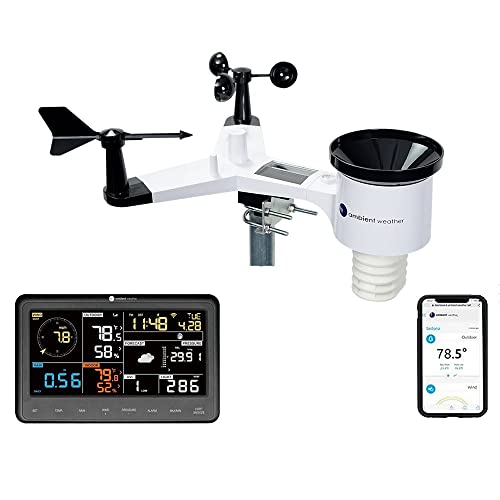
The WS-2902C is the best all-around home weather station because it covers ten measurements, connects to WiFi, and includes a bright color display. Its Osprey sensor array tracks wind speed and direction, rainfall, UV intensity, solar radiation, barometric pressure, and indoor and outdoor temperature and humidity, then calculates dew point, heat index, and wind chill. The console uploads readings to the Ambient Weather Network and other weather services, so conditions can be checked from a phone anywhere.
Setup is straightforward for a station this capable. The array mounts on a pole in an open spot, the console plugs in indoors, and the two link by radio before the console joins the WiFi network. The display shows current conditions in large type, and the app adds history, graphs, and alerts.
The main limits are practical. The mounting pole is not included, so a pole or bracket needs to be bought or built. The console connects only on a 2.4 GHz WiFi network, which is worth confirming first.
Specs
- Sensors: Wind speed and direction, rainfall, UV, solar radiation, barometric pressure, indoor and outdoor temperature and humidity, dew point, heat index, wind chill
- Connectivity: WiFi 2.4 GHz, uploads to Ambient Weather Network and weather services
- Sensor link: RF 915 MHz, up to 330 feet line of sight, about 100 feet under most conditions
- Display: Color LCD console
- Outdoor temperature range: -40 to 149 degrees Fahrenheit
- Wind speed range: 0 to 100 mph
- Power: Console 5V DC adapter included, 3 AAA battery backup not included
WeatherFlow Tempest Weather Station — Best Smart Home
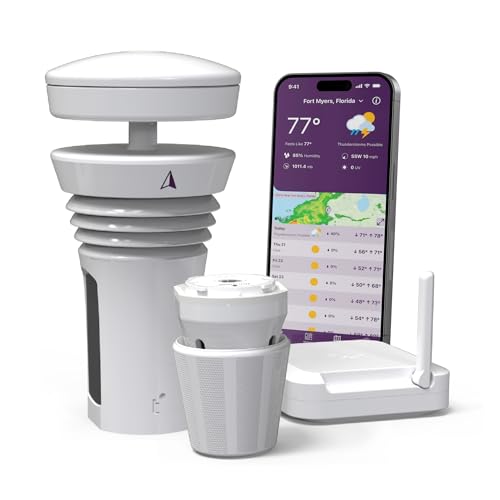
The Tempest takes a different approach: it has no moving parts and no physical display. A single compact sensor measures wind with ultrasonic pulses, rain with a haptic sensor, and lightning with a dedicated detector, while a hub links the unit to WiFi and to the Tempest app. Solar power keeps the sensor running without battery changes, and the sealed design has nothing to clog, freeze, or wear out.
The app is the heart of the system. It shows current conditions, hourly and daily forecasts, and lightning alerts, and it learns from local readings over time to refine its Nearcast forecasts for your exact location.
The trade-off is the lack of a console: anyone who wants to glance at a wall display will need to open the app instead. The haptic rain sensor can also read differently from a traditional tipping-bucket gauge in unusual rain, so gardeners who log rainfall precisely may prefer a cup-based collector. For a phone-first household, the Tempest is the simplest station to live with.
Specs
- Sensors: Ultrasonic wind speed and direction, haptic rainfall, lightning detection, temperature, humidity, UV, barometric pressure
- Display: None included, app and web dashboard only
- Connectivity: WiFi through included hub, Alexa and smart home support
- Power: Solar-powered sensor with battery backup
- Moving parts: None
- Forecasting: Nearcast AI forecasts
Davis Instruments Vantage Vue with WeatherLink Console — Best Accuracy

The Vantage Vue is the accuracy pick, trusted for decades by broadcast meteorologists, farmers, and serious weather enthusiasts. Its integrated sensor suite combines the anemometer, wind vane, rain collector, and temperature and humidity sensors in one rugged housing, and it reports new wind readings every 2.5 seconds across a radio link that reaches up to 1,000 feet. The rain collector measures in 0.01-inch increments, fine enough to separate a light shower from a useful watering rain.
This bundle pairs the sensor suite with the WeatherLink Console, a color touchscreen that shows current conditions, history, and trends. The console connects to WiFi and uploads data to the WeatherLink service for smart home integration and remote access. The suite runs on solar power with a lithium battery backup, and the console runs from wall power with battery backup of its own.
The Vantage Vue costs more than consumer stations, and it shows in the build rather than in flashy extras. This listing is the metric variant, model 6242M, so buyers should confirm the console unit setting before ordering. For anyone who wants the most trustworthy numbers in the yard, the premium is justified by the sensor quality and long service life.
Specs
- Sensors: Wind speed and direction, rainfall, temperature, humidity, barometric pressure
- Update interval: Every 2.5 seconds for wind
- Transmission range: Up to 1,000 feet, 300 meters, line of sight
- Wind speed range: 2 to 200 mph
- Temperature range: -40 to 150 degrees Fahrenheit
- Console: WeatherLink Console with HD color touchscreen, WiFi
- Power: Solar suite with lithium backup, console AC-powered with battery backup
- Model: 6242M, metric variant
AcuRite Iris (5-in-1) Wireless Weather Station 01512 — Best Midrange
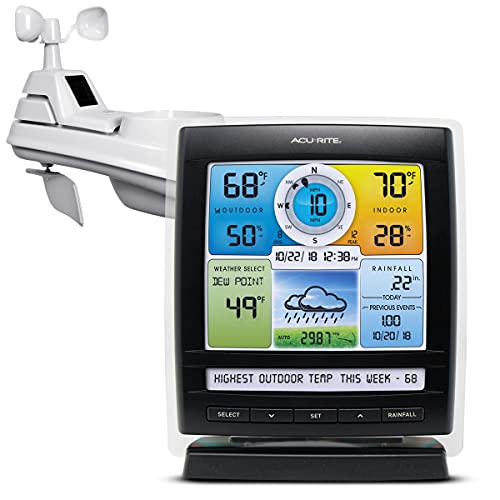
The AcuRite Iris 01512 is the sensible midrange choice for households that want real wind and rain data without paying for a professional suite. Its 5-in-1 outdoor sensor measures temperature, humidity, wind speed and direction, and rainfall, and sends the readings wirelessly to a color display indoors. The display shows indoor and outdoor conditions side by side, so a quick glance covers the whole picture.
Setup is simple, with no WiFi network to join and no app to configure. The sensor mounts outside on a pole or bracket, the console sits on a counter, and the two link automatically. That simplicity is also the main limit: without WiFi, the station keeps its data at home and cannot send alerts to a phone or upload readings to a weather network. It also has no barometer, so pressure trends are not part of the display.
For a garden shed, a kitchen counter, or a cabin, that trade is often the right one. The Iris gives the measurements that matter most for daily decisions, it costs far less than pro-grade suites, and there is nothing to maintain beyond occasional battery changes.
Specs
- Sensors: Temperature, humidity, wind speed and direction, rainfall
- Display: Color display console, indoor and outdoor readings
- Connectivity: Wireless sensor link, no WiFi
- Barometer: Not included
- Sensor: 5-in-1 outdoor sensor, wireless
Newentor Q3 Wireless Weather Station — Best Budget

The Newentor Q3 is the budget pick, and it is honest about what it does. Its large 7.5-inch color display shows indoor and outdoor temperature and humidity, barometric pressure, moon phase, and a 12 to 24 hour forecast in big, readable type. An atomic clock keeps the time exact, temperature alerts warn when conditions cross a set threshold, and the station supports up to three remote sensors, with one included.
What the Q3 does not do is measure wind or rain: there is no anemometer and no rain collector, so it cannot report gusts or rainfall totals. It also has no WiFi, so readings stay on the display and alerts sound at home rather than on a phone. Those limits are the reason for its low cost, and they are acceptable for anyone who mainly wants indoor and outdoor temperature and humidity.
The display runs from a wall adapter with battery backup, and the outdoor sensor runs on batteries with a range of about 200 feet. For a first weather station, a spare room, or a gardener who already owns a rain gauge, the Q3 covers the basics well.
Specs
- Sensors: Indoor and outdoor temperature and humidity, barometric pressure
- Display: 7.5-inch color LCD
- Forecast: 12 to 24 hour forecast, moon phase
- Remote sensors: Up to 3 supported, 1 included
- Sensor range: About 200 feet
- Power: AC and DC adapter, battery backup
Who Should Skip It
A full weather station is not for every home. Anyone who only checks the forecast once a day will get everything they need from a phone app, and a station would add hardware, mounting, and upkeep for little benefit. Renters who cannot mount a sensor outdoors will also struggle to get accurate readings.
Budget buyers should be honest about which measurements they will actually use. A temperature and humidity display covers most daily questions, and paying for wind and rain sensors that never get checked is wasted money. Gardeners who water by rainfall totals, homeowners who watch for frost, and anyone who tracks storms should skip the cheapest displays and choose a station with a real rain collector and wind sensor. Anyone who wants alerts on a phone while away should choose a WiFi model instead.
FAQ
Do I need WiFi for a home weather station?
No. A station with a display console works without WiFi and shows conditions at home. WiFi adds remote access, phone alerts, and uploads to weather networks, which matter if you want to check conditions while away or track history.
Where should I mount the outdoor sensor?
Mount it in an open spot away from trees, rooflines, and fences, high enough to catch clean wind and rain. Keep it level and away from splashback, and avoid placing it under an eave or beside a tall hedge, which under-reports wind and rain on gusty days.
Can a weather station measure snowfall?
Most rain collectors cannot measure snow accurately, since snow can bridge over the collector instead of falling through. A manual rain gauge can measure snow by melting it indoors. Check the sensor design before relying on it for winter totals.
How accurate are home weather stations?
Accuracy varies by sensor quality and placement. Professional-grade suites hold temperature within about a degree and wind within a few miles per hour, while budget displays are less precise. Proper siting matters as much as the hardware.
Final Verdict
The Ambient Weather WS-2902C is the best weather station for most homes because it measures ten conditions, includes a clear color display, and uploads data to WiFi networks and smart home systems. The WeatherFlow Tempest is the best choice for phone-first households that want maintenance-free hardware and lightning alerts. The Davis Vantage Vue is the pick for anyone who wants the most accurate readings and a long service life. The AcuRite Iris 01512 covers the midrange, and the Newentor Q3 is the budget pick for temperature and humidity. Choose by the measurements you will actually use and mount the sensor in the open.
Product and ASIN Reference
| Product | ASIN |
| Ambient Weather WS-2902C WiFi Smart Weather Station | B01N5TEHLI |
| WeatherFlow Tempest Weather Station | B0868WY7NY |
| Davis Instruments Vantage Vue with WeatherLink Console | B0BZT39RNV |
| AcuRite Iris (5-in-1) Wireless Weather Station 01512 | B00N1XCA9M |
| Newentor Q3 Wireless Weather Station | B0836CM7KY |