Key takeaways
- Compare five soil testers, from budget 3-in-1 probes to a chemical NPK kit and a digital 4-in-1 meter, and find the right way to check pH and moisture.
Guessing about soil is one of the fastest ways to waste a season. Plants that yellow, wilt, or refuse to grow are often reacting to soil that is too acidic, too alkaline, too dry, or short on key nutrients, and none of that shows on the surface. A soil tester turns that guesswork into a number you can act on.
The five testers below cover every common approach to home soil testing: a budget analog probe, a chemical kit that reads nutrients as well as pH, a moisture-only probe, a second budget 3-in-1, and a digital 4-in-1 meter that adds temperature. None replaces a professional lab test.
As an Amazon Associate, we earn from qualifying purchases.
Quick Answer
For most home gardeners, the Sonkir MS02 is the best place to begin: it checks moisture, pH, and light with no battery and no setup. Gardeners who need nutrient readings should add the Luster Leaf Rapitest 1601 chemical kit, while the XLUX T10 is the simplest choice when watering is the only question. The digital 4-in-1 meter suits growers who also want soil temperature.
Sonkir MS02 3-in-1 Soil pH Meter
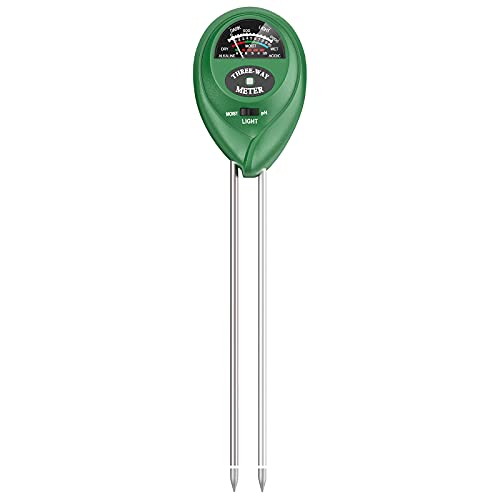
The Sonkir MS02 is the best-selling soil tester on Amazon, and the reason is simple: it does three useful jobs for the cost of a bag of potting mix, with no battery to buy and no calibration to learn. Two metal probes slide into the soil, a switch selects moisture, pH, or light, and a needle dial shows the result. Moisture runs from 1 to 10, pH from 3.5 to 8, and light from 0 to 2000 lux. The probes measure about 7.9 inches, and the whole unit weighs 2.89 ounces.
The pH reading is a rough guide, not a lab result. The maker publishes no accuracy figure, and extension services warn that moisture, temperature, and recent fertilizer can all move the needle on their own. Treat the number as a trend indicator and confirm a low reading with a chemical kit before amending. The meter needs damp soil to work, so water a dry bed first. It cannot test liquids, and the probes should be wiped clean after each use.
Key Specs
| Spec | Detail |
|---|---|
| Measurements | Moisture, pH, light |
| pH range | 3.5 to 8 |
| Moisture scale | 1 to 10 |
| Light range | 0 to 2000 lux |
| Power | None, battery-free |
| Probe length | About 7.9 in |
| Model | MS02 |
| ASIN | B07BR52P26 |


Luster Leaf Rapitest 1601 Soil Test Kit
The Rapitest 1601 is the only pick here that measures nutrients, and that makes it the most useful tool for gardeners who keep asking why plants look hungry even when watering is right. It is a chemical kit: you mix a soil sample with water and a capsule of reagent, shake, and compare the color of the liquid against a chart. Each kit holds 40 tests, ten each for pH, nitrogen, phosphorus, and potash.
This kit is the one most often cited in extension publications as the home diagnostic to reach for first. The pH scale runs from 4.5 to 7.5, and each nutrient reads out as depleted, deficient, adequate, sufficient, or surplus. Color matching has limits: two people can read the same tube differently, and the method is accurate only to about half a pH unit either way. The kit needs distilled water, and the reagent capsules expire, so check the packaging date before buying.
Key Specs
| Spec | Detail |
|---|---|
| Measurements | pH, nitrogen, phosphorus, potash |
| Test count | 40 tests, 10 per nutrient |
| Method | Capsule reagent, color comparison |
| pH range | 4.5 to 7.5 |
| Result time | About 5 minutes |
| Water needed | Distilled water |
| Power | None, battery-free |
| Model | 1601 |
| ASIN | B0000DI845 |
XLUX T10 Soil Moisture Meter
The XLUX T10 does one thing and does it well: it tells you whether the soil down by the roots is dry or wet. A single slim probe in stainless steel slides into the ground, and a large color-coded dial reads from 1 for dry to 10 for wet. There is no pH, no light reading, and no battery, which is exactly the point. It suits pots and raised beds best.
The probe is about 7 inches long, with a recommended insertion depth of 2 to 4 inches. It is less useful for deep-rooted shrubs, where moisture at 4 inches says little about conditions a foot down. The single probe disturbs fewer roots than twin-probe designs. The probe corrodes if left in damp soil, so remove it after each reading and wipe it dry. Do not force it into hard ground, which can bend the probe.
Key Specs
| Spec | Detail |
|---|---|
| Measurements | Soil moisture only |
| Moisture scale | 1 to 10, color-coded dial |
| Probe | Single, 304 stainless steel |
| Probe length | About 7 in |
| Insertion depth | 2 to 4 in |
| Power | None, battery-free |
| Height | 10.24 in |
| Warranty | 18-month limited manufacturer warranty |
| Model | T10 |
| ASIN | B014MJ8J2U |
Atree 3-in-1 Soil pH Meter
The Atree 3-in-1 is the budget twin of the Sonkir: the same pattern of two metal probes, one dial, and three switchable functions, at the lowest cost in this guide. It measures moisture on a 1 to 10 scale, pH from 3.5 to 8, and light from 0 to 2000 lux, with no battery and no setup. It covers the basics for less than the cost of a single bag of fertilizer.
The pH reading is a rough guide, and owner feedback reports that the pH function is the weakest of the three modes. The probes are fragile and can break if forced into hard, dry soil, so moisten the ground first and push gently. As a moisture and light checker it earns its place; as a precision pH instrument it will disappoint. Pair it with the Luster Leaf kit when a pH reading looks off.
Key Specs
| Spec | Detail |
|---|---|
| Measurements | Moisture, pH, light |
| pH range | 3.5 to 8 |
| Moisture scale | 1 to 10 |
| Light range | 0 to 2000 lux |
| Power | None, battery-free |
| Model | RR-07-007 |
| ASIN | B07R4RPS54 |
IRTOV 4-in-1 Digital Soil Moisture Meter
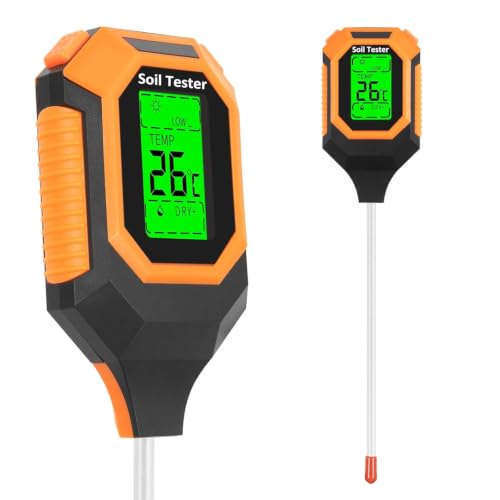
The IRTOV 4-in-1 is the only digital pick in this guide, and the upgrade is visible the moment you switch it on. A large backlit LCD shows moisture, pH, soil temperature, and sunlight intensity as numbers instead of a needle position, which helps in dim greenhouses and early-morning beds. Temperature is the reading that sets it apart: it tells you when soil has warmed enough for seed sowing.
The meter runs on four AAA batteries, which are not included, and warns when power runs low. Its probe settles on a value in under a minute in most soils. Like every probe meter here, it is a soil-only tool: the listing warns not to use it to test water or other liquids, and the pH reading is a relative guide rather than a lab-grade measurement. No pH accuracy figure is published, so treat the number as a trend indicator.
Key Specs
| Spec | Detail |
|---|---|
| Measurements | Moisture, pH, temperature, sunlight |
| Display | Backlit LCD |
| Power | 4 AAA batteries, not included |
| Low battery warning | Yes |
| Use | Soil only, not liquids |
| Manufacturer | AORUIMAER |
| ASIN | B0DCNX5M45 |
How to Choose
Begin with the question you actually need answered. If watering is the problem, a moisture probe is enough, and the XLUX T10 gives the clearest single-purpose answer. If plants look pale or stunted despite regular watering, you need chemistry, not moisture, and the Luster Leaf kit reads nitrogen, phosphorus, and potash alongside pH. If soil temperature matters for sowing dates, only the digital 4-in-1 reads it.
Next, weigh accuracy against convenience. Probe meters give instant answers but rough pH numbers; chemical kits give broader nutrient data but take a few minutes per test and need distilled water; lab tests are most precise but take a week. Most home gardeners do best with a probe for daily use plus a chemical kit for seasonal checks. Match the probe to your soil, and never force a twin-probe meter into baked-hard ground.
Who Should Skip It
Gardeners who already send samples to a cooperative extension lab each season may not need any of these tools, since a lab report covers pH, nutrients, and amendment advice with far more precision than a home kit. The same applies to a single small container with a known potting mix.
Skip the analog probes if you need pH accurate to a tenth of a unit for acid-loving crops such as blueberries, since a rough reading can lead to the wrong amendment. Skip the moisture-only XLUX if you also want pH or light readings. Skip any probe meter for heavy clay that bakes hard in summer, since forcing a probe in can bend or snap the metal.
FAQ
How accurate are cheap soil pH probes?
They give a rough guide, not a lab result. Analog probes do not publish an accuracy figure, and moisture, temperature, and recent fertilizer can all shift the reading. Use them to spot trends, and confirm a surprising result with a chemical kit or a lab test before amending.
Do I need distilled water for a chemical soil test kit?
Yes, for kits such as the Luster Leaf Rapitest. Tap water carries minerals that can contaminate the sample and skew the color comparison. Distilled water is inexpensive and available at most grocery stores.
Can a soil tester measure the pH of water or liquid fertilizer?
No. The probe meters in this guide are soil-only tools, and their listings warn against testing liquids. Liquid pH needs a dedicated liquid pH pen or test strips designed for solutions.
How deep should I push a moisture probe into the soil?
Push it to the depth where the roots actually grow, usually 2 to 4 inches for pots and raised beds. The XLUX T10 is designed for that range. For deep-rooted shrubs, a surface reading says little about moisture a foot down, so dig a small test hole instead.
Final Verdict
The Sonkir MS02 is the best soil tester for most gardeners: it is inexpensive, needs no battery, and answers the three questions that matter most often, moisture, pH, and light, in a single pass. Add the Luster Leaf Rapitest 1601 when you need nutrient data, since no probe in this guide reads nitrogen, phosphorus, or potash. Choose the XLUX T10 when watering is the only question, the Atree 3-in-1 when budget comes first, and the IRTOV 4-in-1 when a backlit display and a temperature reading are worth the extra cost. Test several spots in each bed, write the numbers down, and retest after amending.