Our Short List of 3
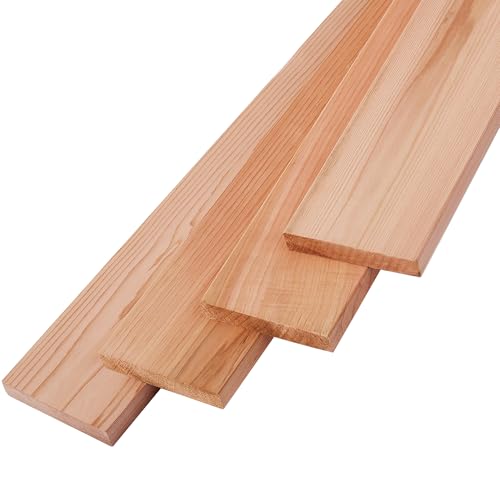
- Best for: A full-size vegetable bed built from rot-resistant cedar with no chemical treatment.
- Material: Western Red Cedar
- Board size: 84 x 5.5 x 0.95 inches (1×6 nominal, 7 ft long)
- Pack: 4 boards, 12.8 sq ft coverage
- Grade: Clear Grade, knot-free

- Best for: Bed ends, edging, and shallow herb beds where a durable hardwood matters more than wall thickness.
- Material: Premium sustainably harvested teak
- Board size: 1/2 x 4 x 4 feet
- Finish: S4S (surfaced four sides)
- Manufacturer: ITI Timber Group, S.A.

- Best for: Corner posts and short ends on a small bed, paired with rot-resistant boards for the long walls.
- Material: Douglas fir
- Board size: 2 in. x 4 in. (1.5 in. x 3.5 in. actual), 3 ft long
- Type: Construction premium board stud
- Treatment: Not pressure-treated
All 3 Picks at a Glance
| Product | Specs | Action |
|---|---|---|
| bingaai Western Red Cedar Decking Boards (4-Pack) 1x6x7 ft |
| Check price on Amazon |
| Sunrise Teak Premium Lumber S4S 1/2 x 4 x 4 ft |
| Check price on Amazon |
| VENTRAL Douglas Fir Board Stud Wood 2 in. x 4 in. (3FT) |
| Check price on Amazon |
Key takeaways
- Compare the best timber for raised garden beds, from rot-resistant cedar and teak boards to sturdy Douglas fir studs, and pick boards that last.
Choosing timber for a raised garden bed is really a choice about how long the bed will last and how safe the soil stays. A board that rots in two seasons means rebuilding the whole bed, moving soil, and disturbing roots, while a board treated with the wrong chemicals can leach into the ground where food grows. The species, thickness, and finish of the timber decide both of those outcomes before a single seed goes in.
This guide is for home gardeners building their first bed, for growers replacing rotted boards, and for anyone weighing a mail-order board against a lumberyard run. We compared real timber boards sold on Amazon by species, board size, thickness, finish, and stated treatment, so you can match a board to your bed size, your climate, and the vegetables you plan to grow.
Quick Picks
As an Amazon Associate we earn from qualifying purchases
| Product | Best for | Key spec from title |
|---|---|---|
| bingaai Western Red Cedar Decking Boards (4-Pack) | A full bed wall that resists rot without treatment | 1x6x7 ft Western Red Cedar boards, 4-pack |
| Sunrise Teak Premium Lumber S4S | A shallow herb bed or a long-lasting liner board | 1/2 x 4 x 4 ft S4S teak board |
| VENTRAL Douglas Fir Board Stud Wood | Corner posts and short ends on a small bed | 2 in. x 4 in. Douglas fir stud, 3 ft |
How to Choose
Pick a species that resists rot on its own
Soil contact is the hardest job timber ever does, because a board sits damp for months at a time with fungi and insects working on it from both sides. Western red cedar and teak carry natural oils and tannins that slow that decay, which is why they outlast pine and fir in the same bed by years. Redwood belongs in the same group, although it is harder to find as a shipped board. Douglas fir is strong and straight, but it has little natural decay resistance, so expect a shorter life unless the bed drains well and the boards dry between waterings. Start with the species, because no finish fully compensates for a wood that rots fast.
Match board thickness to soil load
Wet soil is heavy, and a raised bed is a box full of it. A one-inch board spanning four feet will bow outward over a season unless it has posts close together, while a two-inch board holds its line with less bracing. Boards here run from half an inch to nearly a full inch thick, so thickness is a real trade-off. Thin boards suit shallow beds, liners, and trim, where the load is small. For a bed a foot deep or more, choose the thickest board you can and put a post at every corner and mid-span. Check actual thickness on the listing, since nominal sizes run smaller than the label number.
Check treatment before it touches food soil
Untreated timber is the simplest choice for a bed that grows food, because there is nothing in the wood that can move into the soil. Cedar and teak need no treatment at all, which is a large part of their appeal. Pressure-treated boards are a different matter: modern treatments are copper-based, and many gardeners still prefer to keep them away from edible crops or to line the inside of the bed so soil never touches the wood. If a listing does not state the treatment clearly, treat that as a warning sign and ask the seller before ordering. A board you cannot verify is a board you should not put beside lettuce and carrots.
Measure lengths against your bed plan
Boards arrive in fixed lengths, and every cut is waste unless the plan uses it. A seven-foot board suits a long bed wall, but it needs cutting for a standard four-foot-wide bed, so work out the cuts before you order and count how many boards each wall needs. Short three- and four-foot boards fit bed ends with no cutting at all, which saves time and keeps offcuts out of the bin. Measure the site first, including paths and gates, because a bed that is too long blocks access and a bed that is too wide puts the middle out of reach. Order for the plan, not for the pack size.
The 3 Best Options
bingaai Western Red Cedar Decking Boards (4-Pack) 1x6x7 ft
- Best for: A full-size vegetable bed built from rot-resistant cedar with no chemical treatment.
- Material: Western Red Cedar
- Board size: 84 x 5.5 x 0.95 inches (1×6 nominal, 7 ft long)
- Pack: 4 boards, 12.8 sq ft coverage
- Grade: Clear Grade, knot-free
A full-size vegetable bed built from rot-resistant cedar with no chemical treatment.
Seven-foot boards need cutting for a standard four-foot-wide bed, and cedar calls for stainless steel fasteners to avoid staining.
Western red cedar is the default answer for a timber raised bed, and this four-pack is the closest thing to a ready-made bed wall available online. Four seven-foot boards give you the long sides of a standard bed with one cut each, or two shorter beds cut down, and the clear grade means few knots to weaken a board or catch a trowel. At nearly a full inch thick, the boards hold their shape under soil load better than thin fence pickets, and sanded, eased edges are kind to hands. Cedar needs no chemical treatment, so the soil beside it stays clean for food crops.
Watch out for: Seven-foot boards need cutting for a standard four-foot-wide bed, and cedar calls for stainless steel fasteners to avoid staining.
Sunrise Teak Premium Lumber S4S 1/2 x 4 x 4 ft
- Best for: Bed ends, edging, and shallow herb beds where a durable hardwood matters more than wall thickness.
- Material: Premium sustainably harvested teak
- Board size: 1/2 x 4 x 4 feet
- Finish: S4S (surfaced four sides)
- Manufacturer: ITI Timber Group, S.A.
Bed ends, edging, and shallow herb beds where a durable hardwood matters more than wall thickness.
At half an inch thick, the board flexes under deep soil, so add posts every couple of feet and keep bed depth modest.
Teak is the long-life option in this guide, a dense hardwood whose natural oils have kept it in outdoor service for generations. This single board is surfaced on four sides, so it arrives smooth, straight, and ready to cut, with no rough face to sand before assembly. The four-foot length matches the short end of a standard bed exactly, which makes it a tidy choice for bed ends, edging, or a shallow herb bed where a full-depth wall is not needed. Its half-inch thickness is the compromise: the wood itself will outlast most other boards, but it needs close posts to stay flat under soil.
Watch out for: At half an inch thick, the board flexes under deep soil, so add posts every couple of feet and keep bed depth modest.
VENTRAL Douglas Fir Board Stud Wood 2 in. x 4 in. (3FT)
- Best for: Corner posts and short ends on a small bed, paired with rot-resistant boards for the long walls.
- Material: Douglas fir
- Board size: 2 in. x 4 in. (1.5 in. x 3.5 in. actual), 3 ft long
- Type: Construction premium board stud
- Treatment: Not pressure-treated
Corner posts and short ends on a small bed, paired with rot-resistant boards for the long walls.
Douglas fir has little natural decay resistance, so keep posts out of standing water and expect a shorter life than cedar.
Not every part of a raised bed needs a rot-proof board. Corner posts and short end pieces spend less time in wet soil than the long walls, and that is where a Douglas fir stud earns its place. This three-foot stud is a straight, construction-grade board that cuts cleanly and takes screws without splitting, which makes assembly fast for a first-time builder. The three-foot length suits the short side of a small bed or a set of corner posts cut to height. Douglas fir is the structural member of this guide, so pair it with cedar walls and treat it as the part you may replace first.
Watch out for: Douglas fir has little natural decay resistance, so keep posts out of standing water and expect a shorter life than cedar.
Which One Fits Your Situation
Building your first vegetable bed
Start with the cedar four-pack and use the Douglas fir studs for corner posts. The cedar gives you rot-resistant walls with no treatment to worry about, while the fir posts keep the frame square and cost little to replace later. Cut the seven-foot boards to your bed length, put a post at each corner, and you have a bed that should serve for many seasons.
Replacing boards that rotted out
If pine or fir walls failed after a couple of seasons, replace them with the cedar boards and keep the same footprint, since the old soil and layout still work. Swap the corner posts at the same time, because old posts hide rot behind the boards. Teak ends are worth considering here if the short sides take the most weather.
A small bed on a patio or balcony
Short boards are your friend when space and delivery matter. The four-foot teak board forms a shallow herb bed with no cutting, and a pair of Douglas fir studs makes sturdy corner posts. Keep the bed shallow and the soil light, and check that the patio can drain, since a bed that holds water rots boards far faster.
A bed you want to last a decade or more
Build the long walls from cedar, use teak for the ends and any trim that faces the weather, and reserve Douglas fir for posts only. Good drainage matters as much as species here, so raise the bed slightly, keep soil off the top edge, and re-check the posts each spring. Plan on replacing posts before walls.
Common Mistakes
- Using pressure-treated boards without checking what the treatment is and whether it suits a bed that grows food.
- Building with thin boards and no mid-span posts, then watching the walls bow out once the bed is filled with wet soil.
- Skipping drainage, so boards sit in wet soil all winter and rot from the bottom up.
- Cutting boards to length before measuring the site, and ending up with a bed that blocks a path or a gate.
- Mixing board lengths without a plan, leaving offcuts too short to use anywhere in the build.
Frequently Asked Questions
What timber lasts longest for raised garden beds?
Cedar, teak, and redwood last longest, because their natural oils slow decay in damp soil without any chemical treatment. Expect them to outlast pine and fir by several years in the same bed. Lifespan still depends on drainage and climate, so a bed that drains well and dries between waterings will always beat one that sits in standing water.
Is pressure-treated timber safe for vegetable beds?
Modern pressure-treated timber uses copper-based treatments rather than the older arsenic formulas, but many gardeners still keep it away from food crops. The cautious approach is to build food beds from untreated cedar or teak, or to line a treated frame so soil never touches the wood. If a listing does not name the treatment, do not use that board for vegetables.
How thick should raised bed boards be?
A one-inch nominal board is the practical minimum for a bed about a foot deep, and it still needs corner posts plus a mid-span post on long sides. Two-inch boards hold their shape with less bracing and suit deeper beds. Half-inch boards work only for shallow beds, liners, and trim, where the soil load is small and posts sit close together.
Can I build a raised bed from decking boards?
Yes, decking boards are a common choice, because a 1×6 decking board is close to the ideal size for a bed wall. Check that the boards are untreated or finished only with a food-safe oil, cut them to your bed length, and add posts at the corners and mid-span. Avoid grooved decking profiles, since the grooves trap soil and moisture against the board face.