Key takeaways
- The 2006 Suzuki GSX1300R Hayabusa takes a YT12A-BS battery, not the taller YTX12-BS. Compare three correct-fit AGM and lithium picks with verified specs.
As an Amazon Associate we earn from qualifying purchases.
Affiliate Disclosure: This article contains affiliate links. If you buy through a link on this page, we may earn a commission at no extra cost to you.
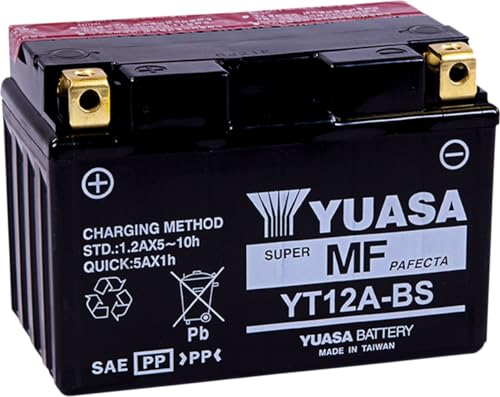

The 2006 Suzuki GSX1300R Hayabusa is a first-generation bike, and that single fact decides almost everything about buying a battery for it. Yuasa’s application data lists the GSX1300R Hayabusa from 1999 through 2007 with one battery type: the YT12A-BS. It is a 12-volt AGM battery rated at 10 amp-hours (10-hour rate) with 175 cold cranking amps, and it measures 150 mm long, 87 mm wide, and 105 mm high. Every pick in this guide matches that size, that terminal layout, and at least that much cranking power, because a battery that is even slightly too tall or too weak will cause problems on a big 1,299 cc inline-four.
Just as important is what not to buy. Many listings push the YTX12-BS for “the Hayabusa” without separating the generations. The YTX12-BS is the specified battery for the 2008-and-later second-generation bike, and it stands 130 mm high — a full 25 mm taller than the YT12A-BS your 2006 model was built around. Some owners have forced taller batteries into modified trays, but as a drop-in replacement for a stock 2006 Hayabusa, the taller case is the wrong part. The same caution applies to the YT12B-BS, which is narrower and taller again. If a listing does not state dimensions, or states a height well above 105 mm, treat it as a battery for a different bike until you have measured your tray and your old battery.
Below you will find three correct-fit options: the original-equipment Yuasa, a sealed AGM alternative built to the same YT12A-BS dimensions, and a lithium upgrade that the manufacturer lists as a direct YT12A-BS replacement. After the picks, there is a full explanation of the specs that matter, how to confirm fitment before ordering, and how to install and maintain the battery once it arrives.
Quick Comparison
| Pick | Type | Capacity | Cranking | Size (L x W x H) | Best for |
|---|---|---|---|---|---|
| Yuasa YUAM32ABS YT12A-BS | AGM, bottle-supplied | 10 Ah | 175 CCA | 150 x 87 x 105 mm | Stock-correct replacement |
| PowerStar AGM YT12A-BS | AGM, sealed | 9.5 Ah | 175 CCA | 150 x 87 x 105 mm | Ready-to-use convenience |
| NOCO Lithium NLP14 | Lithium (LiFePO4) with BMS | 4 Ah (51 Wh) | 500 A starting power | Group 14 case with spacers | Weight saving and long service life |
1. Yuasa YUAM32ABS YT12A-BS — The Stock-Correct Choice
Yuasa is the brand Suzuki fitted at the factory, and the YUAM32ABS is the manufacturer’s own YT12A-BS for this bike. Yuasa’s technical data sheet gives the numbers that define the fitment: 12 volts, 10 Ah capacity at the 10-hour rate (10.5 Ah at the 20-hour rate), 175 CCA, dimensions of 150 x 87 x 105 mm, and a weight of about 3.5 kg filled. The terminal layout is the standard arrangement for this size, with the positive terminal on the left when the terminals face you, matching the cable reach on the 2006 Hayabusa.
This is a bottle-supplied battery, which means it ships dry with a separate acid pack. You fill it, let it stand so the AGM separators absorb the electrolyte, charge it fully, and then seal it with the strip provided. From that point on it is maintenance-free and non-spillable. The extra setup step puts some buyers off, but it has a real advantage: a bottle-supplied battery has effectively been stored without aging, so its service life starts when you activate it, not when it left a warehouse shelf. Yuasa also builds this battery with lead-calcium construction, which the company credits with holding its charge considerably longer in storage than conventional designs — useful on a Hayabusa that may sit between rides.
Choose the Yuasa if you want the least possible guesswork. It is the exact part the application charts name for a 1999–2007 GSX1300R, its 175 CCA matches the original specification, and there is no spacer, adapter, or tray modification involved. The only homework is the activation process: follow the fill and initial-charge instructions exactly, and never install it straight after filling without a full charge, because a first start on a partially charged AGM battery shortens its life.
2. PowerStar AGM YT12A-BS — Sealed and Ready to Install
The PowerStar YT12A-BS, sold by BatteryJack, is built to the same physical pattern as the Yuasa: 150 x 87 x 105 mm, 12 volts, and a sealed AGM design. Its published rating is 9.5 Ah with 175 CCA, and the listing names the Suzuki GSX-R series — including the 1300 Hayabusa — among its intended applications, alongside the GSX-R750, GSX-R1000, and TL1000R, which share this battery size. At roughly 6 pounds, it is also a little lighter than the filled Yuasa.
The practical difference is convenience. This battery arrives sealed and maintenance-free, with no acid handling and no filling step, so installation is a matter of charging it to full (a sensible step with any new battery), swapping it into the tray, and connecting the terminals. The sealed case can be mounted without worrying about vent tubes or spills, and the post-style terminals accept the standard Hayabusa cable ends.
The trade-off is the slightly lower 9.5 Ah capacity figure compared with the Yuasa’s 10 Ah. In everyday terms that is a small reserve difference rather than a starting difference, since both batteries quote the same 175 CCA, and cranking power is what a healthy starter motor actually draws on. For a bike that is ridden regularly and kept on a maintainer over winter, most owners will never notice the gap. For a bike that sits for months at a time, the Yuasa’s storage behavior or the lithium pick below may suit you better. Either way, verify the dimensions printed on the listing against your old battery before ordering, because several similar-looking part numbers exist in this family.
3. NOCO Lithium NLP14 — The Lightweight Upgrade
The NOCO NLP14 takes a different route to the same tray. It is a Group 14 lithium powersports battery rated at 4 Ah and 51 Wh, with a claimed 500 amps of starting power, and NOCO’s own compatibility list includes the YT12A-BS among the lead-acid sizes it replaces. Modular spacers included with the battery let you build the case height up to match legacy battery footprints, which is how a compact lithium pack fills the 2006 Hayabusa’s battery box without rattling around.
The headline benefit is weight. A lithium powersports battery of this class weighs a fraction of the roughly 3.5 kg lead-acid unit it replaces, and on a bike where the battery sits high under the seat, that saving is in about the most noticeable place it could be. NOCO also fits a dynamic battery management system that protects against over-charge, over-discharge, short circuit, and temperature extremes, and the battery needs no activation, no acid, and no watering. The multi-terminal design allows the cables to be mounted from the top, front, or side, which can help with the tight cable routing on the first-generation bike.
There are two honest caveats. First, lithium batteries need a charger with a lithium mode; a basic lead-acid maintainer, especially one with an automatic desulfation pulse, is not the right tool. Second, the 4 Ah figure is not directly comparable with a lead-acid 10 Ah rating, because lithium packs deliver their energy differently and NOCO rates this unit as a lead-acid-equivalent replacement for starting duty rather than for long key-on drain. If your Hayabusa runs accessories with the engine off for extended periods, the deep reserve of the AGM picks is the safer match. If it starts and rides, the NLP14 is a clean, modern upgrade — just confirm the spacer stack and terminal orientation against your tray before the first ride.
Why the 2006 Hayabusa Is Picky About Batteries
The first-generation Hayabusa’s 1,299 cc engine has large pistons and a high compression ratio for its era, so the starter motor works hard, particularly on cold mornings or after the bike has sat. A battery that has lost capacity may still light the dash and run the fuel pump yet fail to crank the engine with conviction, which is why CCA and real capacity matter more here than on a small commuter bike. The stock specification of 175 CCA is the floor, not a target to undercut: every pick above meets or exceeds it.
Fitment is the other trap. The battery lives in a tray sized for the 105 mm height of the YT12A-BS, underneath the seat. Batteries from the same Yuasa family with similar names — YTX12-BS at 130 mm tall, YT12B-BS at 130 mm tall and only 69 mm wide — are intended for other models and other years. Search results and marketplace fitment checkers frequently blur the 1999–2007 and 2008-onwards generations together, so the reliable check is always the same: compare the stated length, width, and height, and the terminal positions, with the battery that came out of your bike.
How to Confirm Fitment Before You Order
Start with the battery already in the bike. Photograph its label and measure it; a YT12A-BS or an equivalent marked BT12A-BS or CT12A-BS, measuring about 150 x 87 x 105 mm, confirms the size. Check which side the positive terminal sits on with the terminals facing you, and note how the cables route, because a reversed-layout battery can leave the leads too short to connect safely. Then compare those four facts — part family, dimensions, polarity layout, and at least 175 CCA — against any listing you are considering. If a seller cannot state the dimensions, choose a seller who can.
It is also worth checking the charging system while the seat is off. A battery that keeps going flat on a 2006 Hayabusa is often a symptom rather than the disease: a failing regulator-rectifier or a parasitic drain will kill a new battery the same way it killed the old one. A simple multimeter check of charging voltage at the terminals with the engine running, and a look at the main connector for heat damage, takes minutes and protects your purchase.
Installation and Care Basics
Disconnect the negative cable first and reconnect it last, and never let a tool bridge the terminals. On a bottle-supplied battery like the Yuasa, complete the filling and the full initial charge before installation. Once fitted, make sure the battery is clamped or padded so it cannot move; vibration is a leading cause of early failure in powersports batteries. Keep the terminals clean and lightly tightened — loose terminals cause hard-starting symptoms that are often blamed on the battery itself.
For storage, AGM batteries self-discharge slowly but still benefit from a quality maintainer during long lay-ups, and they should be stored fully charged. Lithium packs like the NLP14 should be kept on a lithium-compatible charger and stored partially charged if they will sit for a season. Whichever chemistry you choose, a battery that is kept charged will comfortably outlast one that is repeatedly run flat, because deep discharge is what permanently removes capacity from both types.
Frequently Asked Questions
Does a YTX12-BS fit a 2006 Hayabusa?
Not as a stock drop-in replacement. The YTX12-BS is about 130 mm tall, while the 2006 bike’s specified YT12A-BS is 105 mm tall. It is the correct family for the 2008-and-later Hayabusa. For a 2006 model, buy the YT12A-BS size unless you are deliberately modifying the tray and seat clearance.
How many cold cranking amps does a 2006 Hayabusa need?
The original Yuasa specification is 175 CCA. All three picks in this guide meet or exceed that figure. Avoid batteries with a lower CCA rating even if the case size matches, because the big four-cylinder engine is demanding to crank, especially in cold weather.
Can I use a lithium battery in a 2006 Hayabusa?
Yes, provided the lithium battery is listed by its maker as a YT12A-BS replacement, includes a battery management system, and is maintained with a lithium-compatible charger. The NOCO NLP14 above meets those conditions and lists YT12A-BS among the sizes it replaces.
Why does my Hayabusa kill batteries?
Common causes are long storage without a maintainer, a failing regulator-rectifier, corroded or loose terminals, and repeated short trips that never replace the charge used in starting. Test the charging system before blaming the replacement battery.
The Bottom Line
For a 2006 Hayabusa, the correct battery is a YT12A-BS: 12 volts, about 10 Ah, at least 175 CCA, and 150 x 87 x 105 mm. The Yuasa YUAM32ABS is the factory-correct part and the safest choice. The PowerStar YT12A-BS offers the same dimensions in a sealed, ready-to-install case. The NOCO NLP14 is the upgrade path if you want lithium’s weight saving and built-in protection and are willing to use a lithium charger. Whichever you pick, measure first, ignore listings that blur the two Hayabusa generations together, and your bike will start the way a Hayabusa should.