Our Short List of 3

- Best for: Ultralight hikers who want the lightest possible quilt for summer and warm three-season trips.
- Best for: Backpackers who want a genuine down quilt for three-season trips without paying a premium price.
- Best for: Budget-conscious backpackers who camp into the shoulder seasons and need real cold-weather warmth.
All 4 Picks at a Glance
| Product | Specs | Action |
|---|---|---|
| Therm-a-Rest Vesper 32 Quilt |
| Check price on Amazon |
| Paria Thermodown 30 Quilt |
| Check price on Amazon |
| Paria Thermodown 15 Quilt |
| Check price on Amazon |
 WIND HARD Twilight 800FP Quilt |
| Check price on Amazon |
Key takeaways
- Find the best quilts for backpacking, from ultralight 900-fill down to budget three-season picks, and learn how to choose the right warmth, weight, and fit.
A good backpacking quilt can change the way you sleep on the trail. Unlike a traditional mummy bag, a quilt lies over you like the comforter at home, with no zipper running down your side and no insulation compressed flat underneath your body. Your sleeping pad provides the insulation below, while the quilt seals in warmth on top, which is why quilts are often lighter and less restrictive than sleeping bags with a similar temperature rating. For side sleepers, restless sleepers, and anyone counting every ounce, that freedom of movement is a genuine advantage on multi-day trips.
Choosing the best quilts for backpacking means balancing warmth, weight, packed size, and fit. A quilt rated for summer nights in the desert will not keep you comfortable on a cold shoulder-season ridge, and a wide, roomy quilt that drafts in cold air can feel colder than a narrower one that seals well. Fill power, shell fabric, footbox design, and the pad attachment system all shape how warm a quilt feels in real conditions. This guide compares four down quilts sold on Amazon and explains how to match one to your trips, your sleep style, and the seasons you hike in most.
Disclosure: As an Amazon Associate, we earn from qualifying purchases.
Quick Picks at a Glance
| Product | Key Spec | Best For |
|---|---|---|
| Therm-a-Rest Vesper 32 Quilt | 900-fill goose down, 15 oz, 32 degrees F | Ultralight summer and warm three-season trips |
| Paria Thermodown 30 Quilt | 700-fill duck down, 2 lb, 30 degrees F | Budget three-season backpacking |
| Paria Thermodown 15 Quilt | 700-fill duck down, 2 lb 3 oz, 15 degrees F | Cold three-season nights on a budget |
| WIND HARD Twilight 800FP Quilt | 800-fill duck down, 634 g, comfort 32 degrees F | Lightweight value with EN-style ratings |
How to Choose
Temperature rating: Start with the coldest night you expect, then add a safety margin. Most quilt makers publish their own rating rather than a lab-tested figure, and those numbers vary in meaning from brand to brand. Some state a comfort rating, others a lower limit, and a few publish both. If you sleep cold, choose a quilt rated at least 10 degrees colder than the lowest temperature you expect, and treat the headline number as a starting point, not a guarantee.
Fill power and fill weight: Fill power measures how much space one ounce of down lofts to fill, and higher numbers generally mean better warmth for less weight. A 900-fill quilt needs fewer ounces of down to reach the same warmth as a 700-fill quilt, which is why premium ultralight quilts weigh so little. Fill weight, the actual amount of down inside, matters just as much. A quilt with modest fill power but generous fill weight can be just as warm, though it will be heavier and bulkier.
Total weight and packed size: Every ounce matters when you carry shelter, food, and water for days. Ultralight quilts can weigh close to one pound, while budget quilts with heavier fabrics and lower fill-power down often weigh around two pounds. Check whether the listed weight includes the stuff sack, and look at packed dimensions too. A quilt that compresses to a small stuff sack leaves room in your pack for extra food or a warmer layer.
Shell and lining fabric: Most backpacking quilts use 10D or 20D nylon ripstop, sometimes with a durable water-repellent finish. A 10D shell is lighter and packs smaller but needs more care around sharp rocks, tent poles, and zippers. A 20D shell weighs a little more and stands up better to rough handling. A water-repellent finish helps shed dew, but no shell is fully waterproof, so keep your quilt dry inside a pack liner or dry bag.
Footbox design: A sewn-closed footbox is the warmest and simplest option, with no zipper or opening to leak air, and it suits cold sleepers. A zippered or drawcord footbox opens flat like a blanket on warm nights and cinches closed when temperatures drop, which makes the quilt far more versatile across seasons. A ventable footbox is a good middle ground if you hike in places where nights swing from warm to cold.
Pad attachment system: Because a quilt has no bottom, it relies on straps or clips to stay in place on your sleeping pad. Look for elastic straps with clips that let you adjust how snugly the quilt hugs the pad. A good system seals out drafts when you roll onto your side and loosens easily when you want to vent. Wide quilts give restless sleepers more coverage, while narrower quilts save weight but need a better attachment system to keep cold air out at the edges.
Width and length: Quilt sizing is less standardized than sleeping bag sizing, so check the flat dimensions before you buy. As a rule, a quilt should be wide enough to tuck under your sides when you lie on your pad, with extra width if you sleep on your side or toss and turn. Most makers offer regular and long sizes, and some offer wide versions as well.
Top Picks
Therm-a-Rest Vesper 32 Quilt
- Best for: Ultralight hikers who want the lightest possible quilt for summer and warm three-season trips.
Ultralight hikers who want the lightest possible quilt for summer and warm three-season trips.
The Therm-a-Rest Vesper 32 is the lightest quilt in this guide and the clearest example of what premium materials can do for pack weight. It is filled with 900-fill hydrophobic goose down, which lofts high and compresses small, and the regular size weighs about 15 ounces. The 10D nylon ripstop shell keeps the total weight down while a water-repellent finish helps shed dew and condensation. Its sewn footbox traps warmth around your feet with no zipper to create a cold spot, and the quilt pairs with an insulated sleeping pad through an attachment system that holds the edges in place while you move. Rated for 32 degrees, it is aimed at summer trips and warm three-season conditions, where its low weight and small packed size make it easy to carry day after day.
Pros:
– 900-fill goose down delivers strong warmth for only about 15 ounces
– 10D ripstop shell packs down very small
– Sewn footbox eliminates zipper drafts
– Hydrophobic down resists moisture better than untreated down
Cons:
– 32-degree rating limits it to warm conditions
– Delicate 10D fabric needs careful handling
– No zippered footbox, so it cannot open flat as a blanket
Paria Thermodown 30 Quilt
- Best for: Backpackers who want a genuine down quilt for three-season trips without paying a premium price.
Backpackers who want a genuine down quilt for three-season trips without paying a premium price.
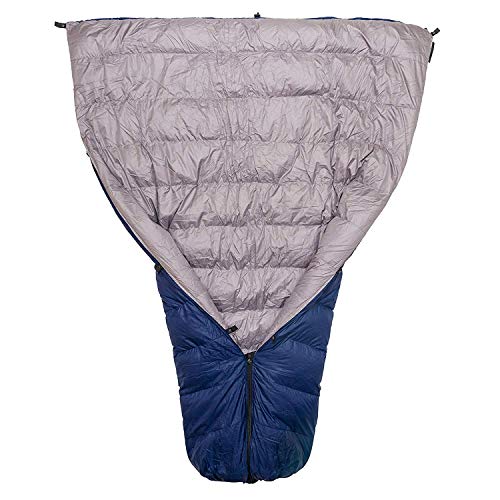
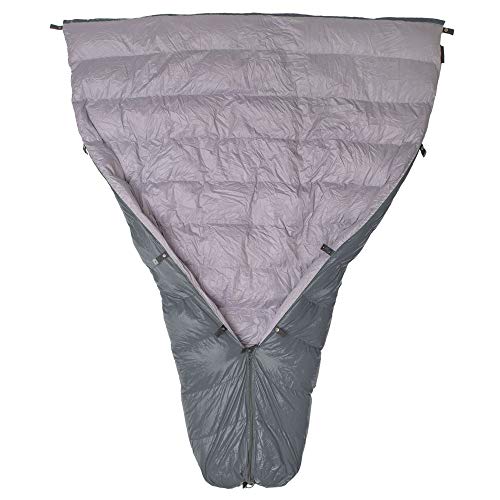
The Paria Thermodown 30 is the budget pick that makes the switch from a mummy bag to a quilt affordable. It is filled with 700-fill-power duck down, with 16 ounces of fill in the regular size, and the quilt weighs about 32 ounces in total. A quarter-length zipper and a ventable footbox let you open the quilt up like a blanket on warm nights or cinch it closed when the temperature falls, while two elastic pad attachment straps with wafer-style clips hold it to your sleeping pad. The shell is 20D ripstop nylon with a polyester pongee lining, and the quilt measures about 78 inches long by 56 inches wide in the regular size, packing down to roughly 9 by 6.5 inches in the included compression sack. It is a straightforward three-season quilt that trades some weight and packed size for a much lower cost than premium ultralight models.
Pros:
– Much lower cost than premium ultralight quilts
– Ventable footbox and quarter zipper add versatility
– Generous 56-inch width suits side sleepers
– Pad straps and compression sack included
Cons:
– About twice the weight of the lightest quilts here
– 700-fill down packs larger than high fill-power down
– Temperature rating is the maker’s own estimate, not a lab-tested figure
Paria Thermodown 15 Quilt
- Best for: Budget-conscious backpackers who camp into the shoulder seasons and need real cold-weather warmth.
Budget-conscious backpackers who camp into the shoulder seasons and need real cold-weather warmth.
The Paria Thermodown 15 takes the same budget-friendly design as the Thermodown 30 and adds the extra down needed for colder nights. Each regular-size quilt is filled with 22 ounces of 700-fill-power duck down, and the total weight comes to about 2 pounds 3 ounces without the stuff sack. It is rated by the maker to 15 degrees Fahrenheit and measures about 78 inches long by 56 inches wide, with a long version available for taller hikers. The 20D ripstop nylon shell and 320T polyester pongee lining are built for regular trail use, and the quilt packs down to about 10 by 7 inches in the included compression sack. Like its warmer-weather sibling, it has a convertible footbox and pad attachment straps, so it works as a blanket on mild nights and seals up when the temperature drops toward freezing.
Pros:
– Warmest budget quilt in this guide, rated to 15 degrees
– 22 ounces of down fill for strong loft
– Wide 56-inch cut fits most sleepers comfortably
– Convertible footbox works across a wide temperature range
Cons:
– Heaviest quilt in this guide at over 2 pounds
– 700-fill down is bulkier than higher fill-power options
– Rating runs optimistic according to owner feedback, so cold sleepers should plan a margin
WIND HARD Twilight 800FP Quilt
- Best for: Weight-conscious hikers who want 800-fill warmth and a clear temperature rating at a moderate cost.
Weight-conscious hikers who want 800-fill warmth and a clear temperature rating at a moderate cost.
WIND HARD Twilight 800FP Quilt
The WIND HARD Twilight is a strong value choice for hikers who want high fill-power down without a premium price tag. It uses 800-fill-power white duck down inside a water-repellent 10D nylon shell, and the lengthened version weighs about 634 grams including its compression sack, with 400 grams of down fill. The listing gives EN-style temperature figures of 32 degrees Fahrenheit for comfort and 23 degrees for the lower limit, which makes the rating easier to compare with lab-tested sleeping bags than most maker estimates. Its bottomless design pairs with a sleeping pad to cut bulk, and the quilt measures about 73 inches long and 54 inches wide in the lengthened size, fitting users up to about 185 centimeters tall. For three-season backpacking, it offers a rare combination of light weight, high-loft down, and a clearly stated temperature range.
Pros:
– 800-fill down at a value price point
– Only about 634 grams in the lengthened size
– Published comfort and limit temperatures aid comparison
– 10D water-repellent shell packs down small
Cons:
– Less well known brand with a smaller support network
– Narrower 54-inch width may feel snug for broad or restless sleepers
– Bottomless design depends heavily on a good insulated pad
Comparison Table
| Quilt | Temp Rating | Fill | Total Weight | Shell | Footbox |
|---|---|---|---|---|---|
| Therm-a-Rest Vesper 32 | 32 degrees F | 900-fill goose down | About 15 oz | 10D nylon ripstop | Sewn closed |
| Paria Thermodown 30 | 30 degrees F | 700-fill duck down | About 32 oz | 20D nylon ripstop | Zippered, ventable |
| Paria Thermodown 15 | 15 degrees F | 700-fill duck down | About 2 lb 3 oz | 20D nylon ripstop | Convertible |
| WIND HARD Twilight 800FP | Comfort 32 degrees F, limit 23 degrees F | 800-fill duck down | About 634 g | 10D water-repellent nylon | Bottomless design |
Buying Guide
Start by matching the quilt to the coldest conditions you will actually face. If your trips are summer-only, a 30- or 32-degree quilt is enough and saves meaningful weight. If you hike in spring and autumn, or camp at altitude where nights turn cold without warning, a 15- or 20-degree quilt is the safer choice. Remember that temperature ratings are not directly comparable across brands unless they use the same testing standard. When only one figure is published, assume it sits closer to a limit than a comfort rating and choose accordingly, especially if you sleep cold.
Next, think about your sleeping pad, because a quilt is only half of a sleep system. A quilt has no insulation underneath you, so the warmth you feel depends on your pad. Pair a summer quilt with a pad rated for the same conditions, and use a higher R-value pad when you push a quilt toward the cold end of its rating. A pad that is too narrow can also let drafts in at the edges, so wide pads pair well with quilts for side sleepers.
Fit is the third decision. Check the quilt’s flat dimensions against your height and shoulder width. Side sleepers and restless sleepers should favor wider quilts, even if that adds an ounce or two, because a quilt that pulls away from your body in the night loses more warmth than the extra fabric costs in weight. Taller hikers should consider a long size rather than sleeping with the quilt pulled tight over their shoulders.
Common mistakes are easy to avoid. The first is buying for the average night instead of the coldest one. The second is ignoring the pad and expecting the quilt to do all the work. The third is choosing the narrowest, lightest quilt and discovering that drafts undo the weight savings. The fourth is skipping a dry bag and letting the down get damp, which collapses loft and warmth. At home, store your quilt loosely in a large cotton or mesh sack, not compressed in its stuff sack, so the down keeps its loft.
Frequently Asked Questions
Are backpacking quilts warmer than sleeping bags?
Neither is automatically warmer. A quilt and a sleeping bag with the same amount of the same down will insulate similarly on top, but a sleeping bag also insulates underneath you, while a quilt relies on your sleeping pad for that. Quilts save weight by removing the insulation and zipper you would compress beneath your body anyway. A quilt feels warmer for its weight when paired with a good insulated pad, while a sleeping bag feels warmer when your pad is thin.
What temperature rating should I choose for three-season backpacking?
For most three-season trips, a quilt rated between 20 and 30 degrees covers the widest range of conditions. Summer-only hikers can go warmer, with a 30- or 40-degree quilt, while spring and autumn hikers should lean toward 15 or 20 degrees. If you sleep cold, choose a rating at least 10 degrees lower than the coldest night you expect. A quilt with published comfort and limit figures is easier to judge than one with a single number.
Do I need a special sleeping pad for a quilt?
You do not need a special pad, but you do need an insulated one. Since a quilt has no bottom insulation, your pad provides all the warmth beneath you. A pad with an R-value matched to your conditions is essential, and wider pads help seal the quilt edges. Most quilts include straps or clips that attach to standard rectangular and tapered pads, so check that the strap system fits your pad width before you buy.
Can I use a backpacking quilt in a hammock?
Yes, many backpackers use quilts in hammocks as top quilts. You will still need insulation underneath, usually an underquilt hung below the hammock, because a sleeping pad is awkward and less effective there. A quilt with a ventable footbox is especially handy, since hammock temperatures can change quickly overnight.
How do I keep a down quilt dry on the trail?
Store the quilt in a waterproof stuff sack or pack liner, and never pack it wet if you can avoid it. Pitch your tent with good ventilation to reduce condensation, and air the quilt out each morning. A water-repellent finish helps with dew, but it will not protect soaked down. If the quilt gets damp, dry it at the next opportunity and fluff it to restore loft.
How long does a backpacking quilt last?
A well-made down quilt can last many years with basic care. The main threats are moisture, compression, and fabric damage. Store it uncompressed at home, keep it dry on the trail, wash it only when needed with a down-specific cleaner, and repair small tears promptly. Higher fill-power down holds its loft longer, and a durable 20D shell outlasts a delicate 10D shell under rough use.
Conclusion
The best quilts for backpacking balance warmth, weight, and cost in a way that matches how and where you hike. The Therm-a-Rest Vesper 32 is the pick for ultralight summer trips, where its 900-fill down and 15-ounce weight are hard to beat. The Paria Thermodown 30 is the smart budget choice for three-season hiking, while the Thermodown 15 adds the warmth needed for cold shoulder-season nights at a similar value. The WIND HARD Twilight sits between them, offering 800-fill down, a light carry weight, and clearly published comfort and limit temperatures. Choose your quilt by the coldest night you expect, pair it with an insulated pad, and give yourself enough width to sleep the way you naturally sleep.