Our Short List of 3
All 4 Picks at a Glance
| Product | Specs | Action |
|---|---|---|
 Mohu Leaf 50 | Check price on Amazon | |
 Mohu Leaf 30 | Check price on Amazon | |
 Mohu Leaf Metro | Check price on Amazon | |
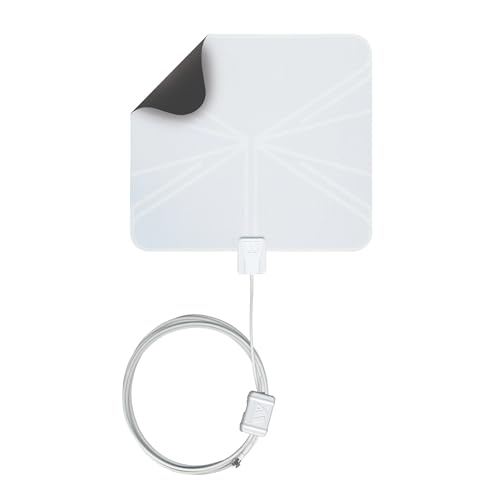 Winegard FlatWave FL5500A | Check price on Amazon |
Key takeaways
- Best HD air antennas for free over-the-air TV: compare range, amplification, UHF/VHF coverage and placement to pick the right indoor antenna for your home.
Introduction
The best HD air antennas let you watch local broadcast channels in high definition without a monthly cable or satellite bill. An over-the-air antenna picks up free signals transmitted by local stations, and because those broadcasts are uncompressed, the picture can look sharper than the same channel delivered through a compressed streaming feed. For many households, a well-chosen indoor antenna is all it takes to receive the major networks, local news, sports and public television.
This guide focuses on indoor HD air antennas, the flat-panel and paper-thin designs that mount on a wall or sit near a window. These models suit apartments, rented homes and anyone who does not want to climb onto a roof. Each antenna below was selected for a different situation: maximum range, a compact room, a tight budget, or a suburban home sitting farther from the broadcast towers.
Choosing the right antenna is less about the biggest range number on the box and more about matching the antenna to your distance from the towers, the construction of your home and the channels you actually want. The sections below explain how to judge those factors, then compare four established indoor models from Mohu and Winegard. Availability details in this article rest on search-index records and independent retailer and review listings, since live stock could not be confirmed directly.
At a Glance
| Product | Best for | Key spec |
|---|---|---|
| Mohu Leaf 50 | Longest indoor range with amplification | 60-mile range, Jolt Switch amplifier, UHF/VHF |
| Mohu Leaf 30 | Simple unamplified reception at a lower cost | 40-mile range, paper-thin reversible panel |
| Mohu Leaf Metro | Small rooms, dorms and RVs | 30-mile range, compact half-size panel |
| Winegard FlatWave FL5500A | Suburban homes needing amplified VHF/UHF | 60-mile range, amplified, 4K and ATSC 3.0 ready |
How to Choose an HD Air Antenna
Distance from the broadcast towers
Range is the first filter. Antenna makers publish a maximum range in miles, but that figure describes reception under favourable conditions, not a guarantee for every living room. A home within 20 miles of the towers can often succeed with a compact unamplified panel, while a home 40 to 60 miles away usually needs an amplified model with a larger element. Before buying, check a free reception map for your address to see how far away your local transmitters sit and which direction they lie in. If your target stations cluster in one direction, almost any multi-directional indoor panel will do; if they spread around you, a multi-directional design matters more.
Amplified or unamplified
An amplifier boosts weak signals, which helps at longer distances, but it can also overload a tuner when signals are already strong, creating dropouts instead of fixing them. Amplified antennas such as the Mohu Leaf 50 and the Winegard FlatWave FL5500A include a switch or a USB-powered amplifier so the boost can be turned off in strong-signal areas. Unamplified antennas such as the Mohu Leaf 30 avoid that risk entirely and suit homes close to the towers. As a rule, start unamplified if you live near the transmitters, and choose amplified if you live farther out or your home sits behind hills, tall buildings or dense trees.
UHF and VHF coverage
Local stations broadcast on UHF channels and on high-VHF channels, roughly channels 7 through 13. Some flat antennas cover UHF only, which means they can miss a VHF station entirely. Every model in this guide covers both UHF and high-VHF, which is the coverage to look for when a local network affiliate broadcasts on a VHF channel. If a reception map shows a station on a low-VHF channel, channels 2 through 6, an indoor flat panel may struggle, and a larger antenna or an attic installation becomes the realistic option.
Placement and cable length
Placement often matters more than the antenna itself. A window or an exterior-facing wall high on the wall usually beats a spot behind the television, and moving an antenna even a short distance can change which channels lock in. Look for a detachable coaxial cable long enough to reach a good window from your television; the models below include cables from 10 to 18.5 feet. A reversible, paintable panel blends into a room, while a freestanding design suits a shelf or a tabletop. Plan to run a channel scan after each move, since the television only finds channels when it rescans.
4K, ATSC 3.0 and future broadcasts
Modern antennas are often labelled 4K-ready or NEXTGEN TV ready, which refers to the ATSC 3.0 broadcast standard now rolling out in many markets. An antenna does not decode 4K by itself; it simply passes the broadcast signal to a compatible tuner. Still, choosing a model rated for 4K and ATSC 3.0 means the antenna will not be the weak link as local stations upgrade. All four antennas in this guide carry that rating.
Build, warranty and returns
A thin panel antenna has little to break, but cable quality, connectors and the amplifier are the parts that fail first. A detachable cable can be replaced cheaply, while a fixed cable cannot. Check the warranty before buying: Winegard and Mohu both back their panels with long warranties, which is a useful sign of confidence in the design. Because reception depends on your specific address, buy from a seller with a straightforward return policy so you can try the antenna at home and exchange it if your channels do not come in.
Product Reviews
Mohu Leaf 50
The Mohu Leaf 50 is the amplified flagship of the Leaf line and the pick for homes that need the longest indoor reach. Its paper-thin panel pairs with the Jolt Switch in-line amplifier, a small module that adds up to 15 dB of gain and can be switched off when signals are strong. Mohu rates the combination at a 60-mile range, covering both UHF and high-VHF channels, and the antenna supports full HD, 4K, 8K and NEXTGEN TV broadcasts depending on local coverage. A 12-foot detachable coaxial cable gives reasonable freedom to place the panel on a window or an exterior wall.
In practice, the Leaf 50 suits a suburban home or a house on the edge of a metro area, where the towers sit far enough away that an unamplified panel drops channels. The multi-directional design means it does not need precise aiming, and the reversible black-and-white faces let it blend into light or dark walls. The panel is paintable, so it can disappear against a painted wall entirely.
The limitations are the usual ones for amplified indoor antennas. The amplifier needs USB power, so a spare USB port or outlet must sit near the television. In a strong-signal area the amplifier can do more harm than good, which is why the switch matters; buyers close to the towers should leave it off or choose the unamplified Leaf 30 instead. The panel itself is large, roughly the size of a placemat, so very small rooms may prefer the Metro.
Pros:
– 60-mile amplified range for distant towers
– Switchable amplifier avoids overload in strong-signal areas
– UHF and high-VHF coverage with 4K and NEXTGEN TV support
– Reversible, paintable panel blends into the room
Cons:
– Amplifier needs USB power near the television
– Large panel may overwhelm a very small room
– Amplification can hurt reception if left on near strong signals
Mohu Leaf 30
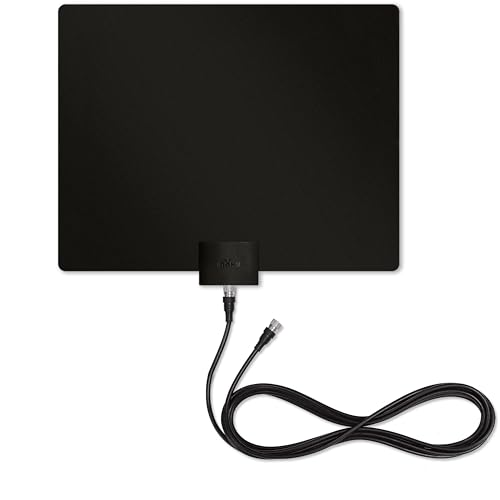
The Mohu Leaf 30 is the original paper-thin Leaf and the straightforward choice for homes within about 40 miles of the towers. It is unamplified, which keeps setup to a single step: connect the coaxial cable, mount the panel, run a channel scan. There is no amplifier to power, no switch to set, and nothing to overload a tuner. The panel covers UHF and high-VHF, supports 4K-ready broadcasts, and ships with a 10-foot detachable coaxial cable.
The Leaf 30 has the longest track record of any antenna in this guide. The design launched the flat-panel antenna category, and the model has remained in production through many revisions of the Leaf line. Its reversible, paintable surface works on a wall or a window, and the thin profile makes it easy to hide behind a curtain or a picture frame.
The trade-off for the simplicity is range. At a published 40 miles, the Leaf 30 is not the pick for a rural home or a house shielded by hills. It also has no amplifier to add later, so if the first scan misses channels, the next step is a different antenna rather than a setting change. For a city apartment or a home with clear line of sight to the towers, however, it is often all that is needed.
Pros:
– Simple unamplified setup with no power supply needed
– 40-mile range suits city and near-suburban homes
– Long-running, well-established design
– Reversible and paintable for discreet mounting
Cons:
– No amplifier for distant or obstructed signals
– 10-foot cable is shorter than amplified rivals
– Not suited to rural or heavily shielded locations
Mohu Leaf Metro
The Mohu Leaf Metro is half the size of the standard Leaf, built for places where a full-size panel is impractical: dorm rooms, small apartments, RVs and bedrooms with a single window. It covers UHF and high-VHF with a published 30-mile range, supports 4K and 8K broadcasts and NEXTGEN TV, and ships with a 12-foot cable despite its compact footprint. Like its larger siblings, the panel is reversible and paintable.
The Metro makes sense when the towers are close and the room is small. A city dweller with transmitters a few miles away gains nothing from a 60-mile amplified panel and loses wall space to it; the Metro delivers the same channels from a panel that tucks behind a small television or onto a narrow strip of window. It is also the most portable option here, easy to move between rooms or take along in an RV.
The compromise is headroom. A 30-mile rating leaves little margin if the home sits behind a concrete building or the towers sit at the edge of that range. There is no amplifier, so a weak-signal room cannot be rescued by a switch. Buyers should treat the Metro as a close-range specialist rather than a general-purpose antenna.
Pros:
– Compact half-size panel fits small rooms and RVs
– 12-foot cable gives placement flexibility for its size
– UHF and high-VHF coverage with 4K and NEXTGEN TV support
– Easy to move between rooms
Cons:
– 30-mile range is the shortest in this guide
– No amplifier for weak-signal situations
– Limited margin in obstructed or concrete buildings
Winegard FlatWave FL5500A
The Winegard FlatWave FL5500A is the amplified rival to the Leaf 50 and the pick for suburban homes that want a different engineering approach. Its patented dual-band element is built into an ultra-thin panel, and the amplified version adds TwinAmp technology with a published 60-mile range for high-VHF and UHF signals. The antenna is 4K-ready and ATSC 3.0 ready, and the kit includes an 18.5-foot cable, the longest in this guide, which helps when the best window sits far from the television.
Winegard pairs the antenna with a channel-finder app that maps local transmitters, a practical aid for aiming and placement. The panel is dual-colour, with a white face and a black reverse, so it suits light or dark walls. The FlatWave line has been reviewed and recommended by multiple technology publications over many years, and the same model is stocked by national retailers including Tractor Supply, which speaks to its staying power.
The FlatWave Amped is not the cheapest indoor antenna, and its amplifier, like any amplifier, can overload a tuner in a strong-signal area. The panel is also a fixed shape that cannot be trimmed, so a very narrow window may not suit it. For a suburban home at moderate to long distance from the towers, those are acceptable trade-offs for the range and the long cable.
Pros:
– 60-mile amplified range with TwinAmp technology
– Longest included cable in this guide at 18.5 feet
– 4K and ATSC 3.0 ready with UHF and high-VHF coverage
– Channel-finder app helps with placement
Cons:
– Amplifier can overload tuners in strong-signal areas
– Higher cost than unamplified flat panels
– Fixed panel shape may not fit very narrow windows
Which One Fits You
Match the antenna to your distance first. Within 30 miles with clear line of sight, the Mohu Leaf Metro covers the essentials in the smallest package, and the Leaf 30 adds range headroom for the same kind of home. Between 30 and 60 miles, or behind hills and tall buildings, choose an amplified model: the Mohu Leaf 50 for its switchable amplifier and paintable panel, or the Winegard FlatWave FL5500A for its longer cable and channel-finder app. Renters and apartment dwellers should favour the reversible, paintable panels that leave no marks, while RV owners will appreciate the compact Metro. Whatever you choose, place it high near a window, rescan after every move, and remember that a published range is a maximum under good conditions, not a promise for every address.
FAQ
Do HD air antennas really give free channels?
Yes. Local stations broadcast over the air without charge, and an antenna plus a television with a tuner is enough to receive them. No subscription is involved, and the channels include major networks, local news and public television where coverage exists.
How many channels will I get?
That depends on your distance from the transmitters, local terrain and the antenna. A home near a city can often receive dozens of channels, including subchannels, while a rural home may receive far fewer. A reception map for your address gives a realistic estimate before you buy.
Do I need an amplified antenna?
Not always. Amplification helps when signals are weak because of distance or obstructions. Close to the towers, an unamplified antenna often performs better because an amplifier can overload the tuner. Amplified models with a switch, such as the Leaf 50, offer both options.
Can an indoor antenna receive 4K channels?
An antenna rated 4K-ready passes the broadcast signal to the television; whether you see a 4K picture depends on the station broadcasting in that format and on your television having a compatible ATSC 3.0 tuner. The antenna itself does not create the picture quality.
Where should I place an indoor antenna?
High on a wall or window facing the broadcast towers usually works best. Avoid placing the panel behind the television or inside a metal cabinet. Move it in small steps and rescan channels after each move to find the strongest position.
Will an antenna work in an apartment?
Yes, indoor flat-panel antennas are designed for apartments. A window-facing placement usually gives the best results, and the thin panels can be mounted with removable adhesive or small pins, which suits rented homes.
Conclusion
The best HD air antennas turn free broadcast signals into a reliable source of local high-definition television. For close-range city homes, the Mohu Leaf Metro and Leaf 30 cover the essentials with simple, unamplified designs. For suburban homes farther from the towers, the amplified Mohu Leaf 50 and Winegard FlatWave FL5500A add the range and the switchable boost that weak signals need. Check your distance to the transmitters, choose amplified or unamplified accordingly, and place the panel high near a window. With the right match, an indoor antenna can replace a monthly bill with a one-time purchase that keeps delivering free channels.
Disclosure: As an Amazon Associate, we earn from qualifying purchases.