Our Short List of 3

- Best for: Gardeners who want one kit that can change shape as the plot evolves
- Height: 17 inches
- Configurations: 9 layouts from one kit, footprints from 2 x 2 ft up to 8 x 2 ft
- Material: VZ 2.0 zinc, magnesium and aluminium coated steel with AkzoNobel paint
- Edging: Rolled edges with heavy-duty rubber safety edging
- Best for: Vegetable growers who want maximum root depth in a standard eight-by-four footprint
- Size: 8 x 4 x 2 ft
- Growing depth: 24 inches
- Capacity: Holds up to 478 gallons of soil
- Material: Alloy steel, metal and rubber, per the listing material field

- Best for: Growers who prefer untreated cedar and the simplest possible assembly
- Size: 4 ft wide x 8 ft long x 7 in high
- Soil capacity: Up to 18.7 cubic feet
- Wood: Untreated, chemical-free North American cedar
- Boards: Smooth sanded, 3/4 inch thick
All 5 Picks at a Glance
| Product | Specs | Action |
|---|---|---|
| Vego Garden 17″ Tall 9-in-1 Modular Raised Garden Bed Kit |
| Check price on Amazon |
| Best Choice Products 8x4x2ft Outdoor Metal Raised Garden Bed |
| Check price on Amazon |
| Greenes Fence Premium Cedar Raised Garden Bed RC48967 |
| Check price on Amazon |
 Land Guard 8x4x1 ft Galvanized Raised Garden Bed Kit |
| Check price on Amazon |
 FOYUEE Galvanized Raised Garden Bed 8x4x1ft |
| Check price on Amazon |
Key takeaways
- Compare five raised garden bed kits, from modular metal and deep steel to untreated cedar, and choose the right size, depth and material for your plot.
Buying a raised garden bed looks simple until you measure the plot and do the soil maths. Footprint decides how much you can plant, wall height decides how much fill you must buy and haul, and material decides how the frame ages outdoors. A bed that suits deep-rooted tomatoes on open ground can be entirely wrong for a narrow side yard or a gardener who wants to reconfigure the layout next spring.
This guide is for first-time bed buyers, vegetable growers replacing rotted timber frames, and anyone moving up from pots. The five kits below were selected from their Amazon listing names and specifications, covering modular metal, deep steel, untreated cedar and two galvanized options at the classic eight-by-four size.
Quick Picks
As an Amazon Associate we earn from qualifying purchases
| Product | Best for | Key spec |
|---|---|---|
| Vego Garden 17″ Tall 9-in-1 Modular Raised Garden Bed Kit | Gardeners who may reshape the plot later | 17 in tall, 9 layouts from one kit |
| Best Choice Products 8x4x2ft Outdoor Metal Raised Garden Bed | Deep-rooted vegetables in a full-size plot | 24 in growing depth, 478-gallon capacity |
| Greenes Fence Premium Cedar Raised Garden Bed RC48967 | Growers who want untreated cedar and tool-free assembly | 4 x 8 ft cedar frame, 3/4 in boards |
| Land Guard 8x4x1 ft Galvanized Raised Garden Bed Kit | A first large metal bed with an oval outline | Q195 galvanized sheet, 0.78mm average thickness |
| FOYUEE Galvanized Raised Garden Bed 8x4x1ft | A rectangular metal bed with crossbar support | 96 x 48 x 12 in, strengthened crossbar |
How to Choose
Footprint and Reach Across the Bed
Start with the space you actually have, then check that you can reach the middle without stepping into the soil. Four feet is the practical maximum width for a bed tended from both sides, which is why so many kits settle at eight by four feet. The Vego kit breaks that pattern: its panels build nine layouts, including a long, narrow eight-by-two arrangement that suits fence lines and side yards where a four-foot width would block the path. Measure the plot, allow walking room on every side you plan to work from, and only then compare lengths.
Wall Height and the Soil It Demands
Height is the specification buyers most often underestimate, because every extra inch multiplies the fill you need to buy, move and pay to replace later. A seven-inch cedar frame holds a modest layer over existing ground, a twelve-inch metal bed suits most vegetables, and the seventeen-inch Vego or twenty-four-inch Best Choice Products beds give roots far more room while reducing how far you bend. Deeper beds also forgive poor native soil, since roots can stay inside the mix you added. Match the height to your crops and your knees, not to the biggest number on the page.
Material: Coated Steel, Galvanized Steel or Cedar
Metal and wood age in opposite ways, and the listings show three distinct approaches. Vego uses steel coated with zinc, magnesium and aluminium under a paint finish, and adds rubber edging over the rolled top edge. Land Guard and FOYUEE rely on galvanized sheet, which keeps the design simple and the panels light. Greenes takes the timber route with untreated North American cedar boards that weather toward grey rather than holding a painted finish. None of these is automatically superior: coastal air, harsh sun and constant irrigation all punish frames differently, so favour the material whose upkeep pattern fits your climate.
Assembly Method and Panel Support
How a kit goes together affects both your first afternoon and its fifth season. The Greenes frame slides together on dovetail joints with no tools and no hardware to lose. Panel kits such as the Vego bolt together with an included hand wrench, which takes longer but lets you reconfigure or replace a section. Long metal walls also need bracing once soil pushes outward, so look for the support details in the listing: the FOYUEE names a strengthened crossbar, and the Best Choice Products bed lists three stabilizing rods across its two-foot-deep frame.
The 5 Best Options
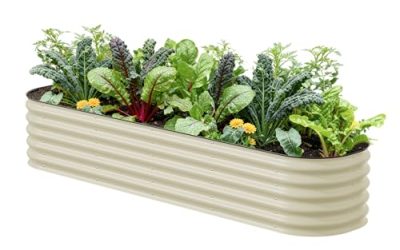
Vego Garden 17″ Tall 9-in-1 Modular Raised Garden Bed Kit
- Best for: Gardeners who want one kit that can change shape as the plot evolves
- Height: 17 inches
- Configurations: 9 layouts from one kit, footprints from 2 x 2 ft up to 8 x 2 ft
- Material: VZ 2.0 zinc, magnesium and aluminium coated steel with AkzoNobel paint
- Edging: Rolled edges with heavy-duty rubber safety edging
Gardeners who want one kit that can change shape as the plot evolves
Soil volume changes with each layout, so calculate fill for the configuration you will actually build
Choose this kit when the garden layout is not settled yet. One set of coated steel panels builds nine different footprints, from a compact two-by-two square to a long eight-by-two rectangle, so the same purchase can start beside a fence and later become a wider bed in open ground. At seventeen inches tall it holds enough depth for root vegetables such as carrots, and the rolled edges with rubber trim make leaning across the top more comfortable. Assembly is a bolt-by-bolt job with the included wrench, so allow a proper afternoon rather than a spare half hour.
Best Choice Products 8x4x2ft Outdoor Metal Raised Garden Bed
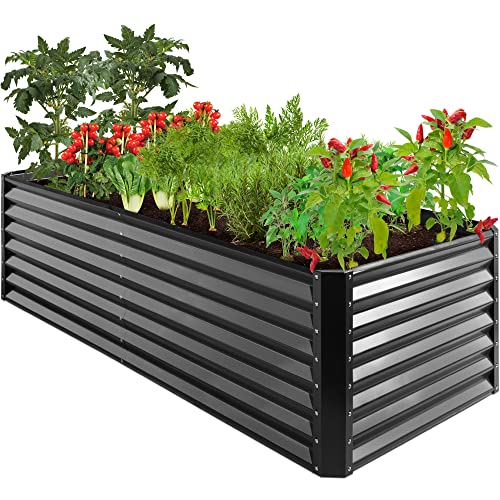
- Best for: Vegetable growers who want maximum root depth in a standard eight-by-four footprint
- Size: 8 x 4 x 2 ft
- Growing depth: 24 inches
- Capacity: Holds up to 478 gallons of soil
- Material: Alloy steel, metal and rubber, per the listing material field
Vegetable growers who want maximum root depth in a standard eight-by-four footprint
The fill volume is large, so plan a bulk delivery or many bags before the kit arrives
This is the deepest bed in the group, and depth is the whole point of it. The eight-by-four frame stands two feet tall, giving medium- to deep-rooting crops such as broccoli and beans a full twenty-four inches of soil while lifting the working surface closer to your hands. The listing states a capacity of up to 478 gallons, which tells you plainly that filling it is a bulk-soil job rather than a few bags from the car. Three stabilizing rods brace the long sides against that soil weight, assembly uses tool-free wingnut bolts, and there is no bottom panel, so roots can continue into the ground below.
Greenes Fence Premium Cedar Raised Garden Bed RC48967
- Best for: Growers who prefer untreated cedar and the simplest possible assembly
- Size: 4 ft wide x 8 ft long x 7 in high
- Soil capacity: Up to 18.7 cubic feet
- Wood: Untreated, chemical-free North American cedar
- Boards: Smooth sanded, 3/4 inch thick
Growers who prefer untreated cedar and the simplest possible assembly
Seven-inch walls give limited depth for deep-rooted crops unless you stack a second kit
Timber traditionalists should start here. The frame is built from untreated, chemical-free North American cedar, which suits growers who keep additives away from food beds and accept that the wood will weather to a silver-grey finish over time. Boards are three-quarter-inch stock, smooth sanded, and they slide into two-and-a-half-inch square corner posts on dovetail joints, so assembly needs no tools and no hardware bag. At seven inches high and holding up to 18.7 cubic feet, this is a shallower, more manageable bed than the metal kits, and the routed posts allow stacking or expansion with additional kits later.
Land Guard 8x4x1 ft Galvanized Raised Garden Bed Kit
- Best for: First-time metal bed buyers who want a full-size footprint without extra features
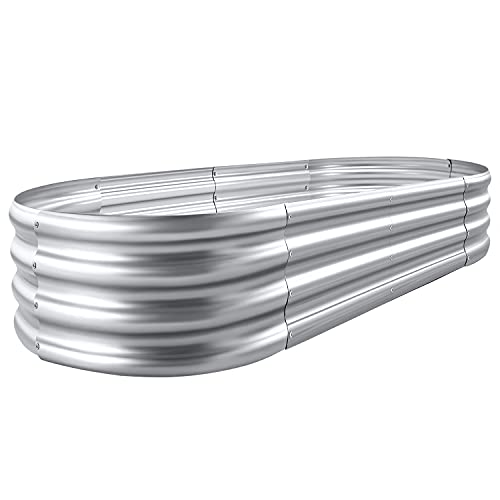
- Size: 8 x 4 x 1 ft
- Volume: 28.56 cubic feet
- Material: Q195 galvanized metal sheet, 0.78mm average thickness and up to 1.56mm at overlaps
- Coating: Double-layer anti-corrosion galvanizing
First-time metal bed buyers who want a full-size footprint without extra features
The listing gives no edge trim, so handle panel edges with gloves during assembly
Land Guard keeps the formula plain: an oval galvanized frame at the full eight-by-four footprint, one foot tall, with a listed volume of 28.56 cubic feet. The sheet is Q195 galvanized metal at an average 0.78mm thickness, doubling to 1.56mm where panels overlap, and a double-layer galvanizing treatment handles corrosion protection. The oval outline has no square corners to align, and the open base lets roots pass into the soil underneath while excess water escapes. It is a straightforward first metal bed for courtyards, yards and greenhouses, provided you are happy working at a twelve-inch wall height.
FOYUEE Galvanized Raised Garden Bed 8x4x1ft
- Best for: Row planting and grid layouts that need a rectangular galvanized bed
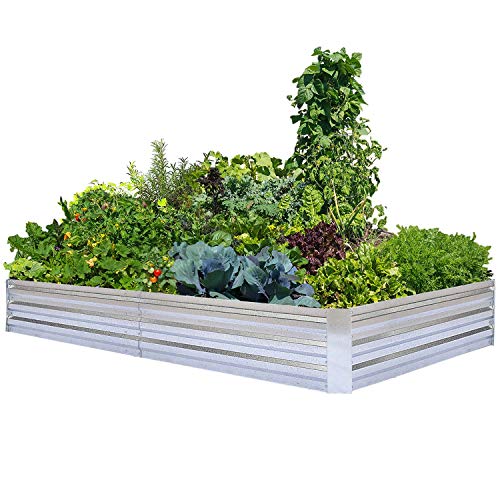
- Assembled size: 96 x 48 x 12 inches (8 x 4 x 1 ft, 1 piece)
- Capacity: 32 cubic feet
- Material: Alloy steel and metal with a rust-resistant galvanized finish
- Shape: Rectangular box planter
Row planting and grid layouts that need a rectangular galvanized bed
Confirm the single-piece size option at checkout, since the same listing family includes multi-packs
FOYUEE covers the same eight-by-four-by-one-foot ground as the Land Guard but in a rectangular box shape, which some growers prefer for row planting and for lining beds up in a grid. The galvanized steel panels overlap, and a strengthened crossbar with an anti-rust coating braces the long sides once the bed is filled. The open bottom supports drainage and lets roots reach the ground below, and the listing frames the bed for vegetables, herbs and flowers in outdoor settings. If your garden plan is drawn in straight lines and right angles, this is the galvanized option shaped to match it.
Which One Fits Your Situation
Your First Vegetable Plot on Ordinary Ground
Begin with the Land Guard or the FOYUEE at eight by four by one foot. Twelve inches of added soil covers most vegetable roots, the fill volume stays manageable, and the open base forgives uneven native soil. Pick the Land Guard for its oval galvanized sheet, or the FOYUEE when straight rows and a crossbar-braced rectangle fit your layout better.
Deep Roots, Poor Soil or Tired Knees
Look at the two taller kits. The Best Choice Products bed gives a full twenty-four inches of depth in a fixed rectangle, while the Vego stands seventeen inches tall and can narrow to two feet wide for fence lines. Both reduce bending and let roots stay in your added mix instead of struggling into weak ground below the frame.
A Natural Look With No Coatings Near Food
The Greenes cedar bed is the only untreated timber option here, and its dovetail frame assembles without tools, screws or painted finishes. Its seven-inch walls suit herbs, salads and flowers, or vegetables grown over decent existing soil. Gardeners wanting more depth from the same system can stack or expand it later using the routed corner posts.
A Plot That Keeps Changing Shape
Renters, community gardeners and anyone still redrawing the garden should take the Vego kit. Nine configurations from one panel set means the bed can start as a small square, stretch along a wall, then settle into a larger rectangle when space opens up. No other kit in this list can be rebuilt into a different footprint without buying a second frame.
Common Mistakes
- Ordering the bed before calculating soil volume, then discovering a two-foot-deep frame needs a bulk delivery rather than a few bags.
- Choosing a bed wider than four feet and having to step into the soil to reach the centre, compacting the mix you just added.
- Placing a metal bed in full afternoon sun without considering how warm the panels and the soil edge can become in hot climates.
- Filling a tall bed entirely with bagged mix when the lower portion could be built up gradually over the first seasons.
- Ignoring the assembly method, then finding that a bolt-together kit needs a free afternoon while a dovetail cedar frame would have suited a shorter setup window.
Frequently Asked Questions
How deep should a raised garden bed be for vegetables?
Most vegetables grow well in twelve inches of soil, which is why the one-foot Land Guard and FOYUEE beds work as general-purpose choices. Root crops and deep-rooting plants benefit from the seventeen inches of the Vego or the twenty-four inches of the Best Choice Products bed, while shallow herbs manage in the seven-inch Greenes cedar frame over reasonable ground.
Do raised garden beds need a bottom?
None of the five kits here relies on a closed floor. The Best Choice Products listing states plainly that no bottom panel is included, and the galvanized beds use open bases. An open bottom drains freely and lets roots continue into the ground, but it also means weeds from below can enter, so many growers lay cardboard or fabric under the fill first.
Is galvanized or coated steel safe for growing food?
The listings approach this through materials rather than promises. Vego specifies a zinc, magnesium and aluminium coated steel with a paint finish described as USDA compliant, while Land Guard and FOYUEE use galvanized sheet. Greenes avoids metal entirely with untreated cedar. If food-growing materials are your deciding factor, compare those listing specifications directly and choose the construction you are most comfortable planting into.
Can one person assemble these beds alone?
The Greenes cedar frame is the simplest solo job because its dovetail boards slide into the corner posts with no tools. Panel kits take longer: the Vego bolts together with an included hand wrench, and long eight-foot metal walls are easier to keep aligned with a second pair of hands, even when the fasteners themselves need no power tools.